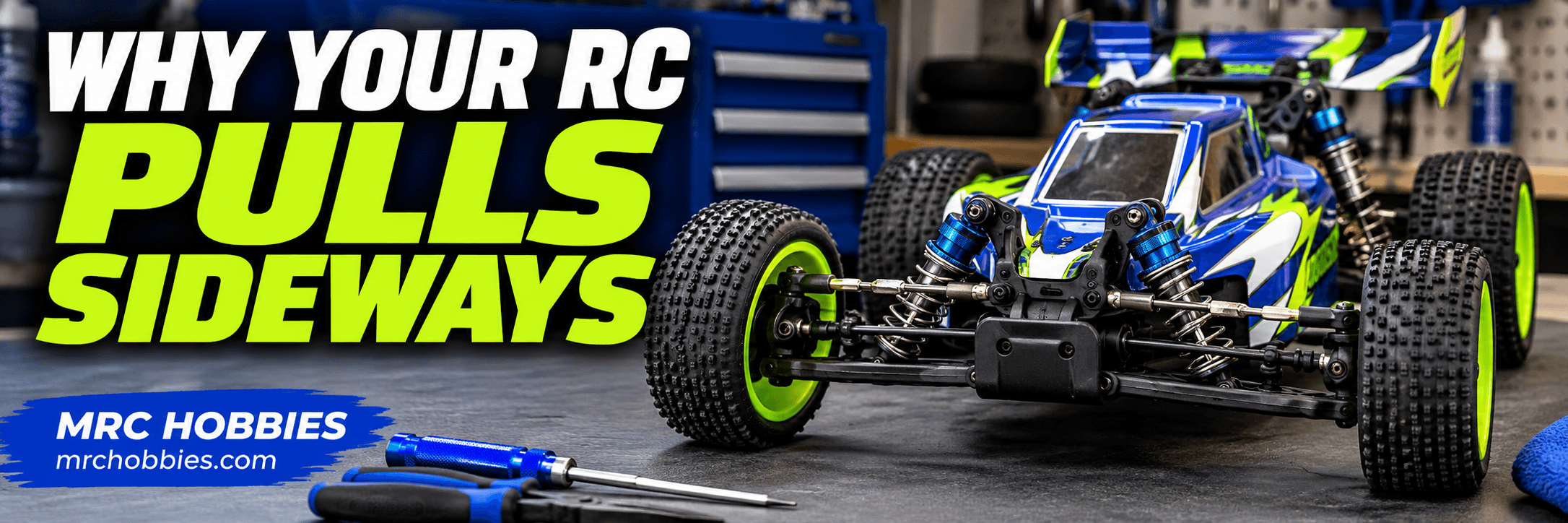
Do not begin by turning the trim all the way
A car that constantly drifts left or right can make a simple run frustrating.
Steering trim may correct a small neutral offset, but it cannot repair a bent link, damaged tire, binding wheel, or inconsistent servo.
The first useful step is observing when the problem appears.
Does the car pull while coasting, accelerating, or braking? Did it begin after a crash? Does the steering return to the same position every time?
These clues help narrow the cause.
Start with the test surface
A sloped, rough, or uneven surface can influence the car’s path.
Use a reasonably flat, open area and test at low speed. Repeat in opposite directions along the same area to see whether the ground is influencing the result.
Wind, surface grip, and driving input can complicate comparisons.
Do not attempt a high-speed diagnosis before checking basic condition.
Check tires and wheels
Compare the left and right tires.
Look for differences in diameter, wear, damage, tread contamination, and inserts. Check wheel mounting and loose hardware.
A tire that has partly detached from its wheel can behave differently under acceleration or cornering.
Also inspect for rubbing against the body or suspension. A wheel can turn freely while raised but make contact when the suspension compresses.
Inspect steering links
With the battery disconnected, check for bent links, loose joints, damaged rod ends, and obstructions.
Compare both sides against the parts diagram. Similar appearance does not always mean identical geometry is intended.
Do not straighten or adjust components blindly after a crash. Identify damaged parts and replace them as required.
What trim can and cannot do
Trim shifts the steering’s commanded neutral position.
It is useful for a small offset when the system is healthy. If large trim is needed, investigate mechanical centring, linkage setup, and radio settings.
If steering returns inconsistently, trim will not solve the underlying issue.
Correct servo centring and horn installation depend on the vehicle’s procedure. Avoid forcing the servo by hand.
Observe the symptom
When the car pullsAreas worth checkingDuring gentle coastingSurface, wheel direction, rubbing, resistanceMainly under accelerationTires, drivetrain, suspension, steering movement under loadMainly while brakingTires, brake behaviour, alignment, mechanical conditionAfter steering inputServo return, linkage friction, servo saverImmediately after a crashBent or displaced components
This table guides inspection rather than confirming a diagnosis.
Check alignment
Camber and toe affect wheel geometry. Unequal or damaged settings can contribute to unusual handling.
Establish normal ride height, then measure according to the manual.
Remember that toe and trim are different. Altering both links to hide an offset may create an incorrect relationship between the wheels.
Use the factory baseline before experimenting.
Check mechanical resistance
Inspect bearings, shafts, and wheel hubs for contamination or binding.
Manufacturer guidance notes that debris around shafts and drive components can obstruct movement. traxxas.com
Follow the service procedure to isolate the affected area. Different drivetrain designs can make raised-wheel tests behave differently, so do not diagnose solely from one wheel’s free-spin time.
Steering electronics and stabilisation
Where fitted, check gyro or steering-stabilisation settings according to the instructions.
Incorrect direction, setup, or mounting can produce unexpected steering behaviour. A radio setting may also have changed accidentally.
Record the original configuration before testing adjustments.
If the servo jitters or moves unpredictably, inspect power supply and connections as well as the servo itself.
Common mistakes to avoid
Avoid using large trim to hide damage, judging alignment by eye, and testing on a visibly sloped surface.
Do not replace the servo before checking the linkage and power supply.
Final thoughts
A car that pulls to one side needs a methodical inspection.
Start with the surface and tires, then inspect steering, alignment, drivetrain condition, and electronics. Fix the cause before applying a small final trim adjustment.
Shop: MRC Hobbies
Visit: MRC Hobbies, 201, P. N. Kothari Industrial Estate, next to Navkar Hospital, Bhandup West, Mumbai, Maharashtra 400078
Phone / WhatsApp: +91 77840 93093
Instagram: @mrchobbies
YouTube: MRC Hobbies