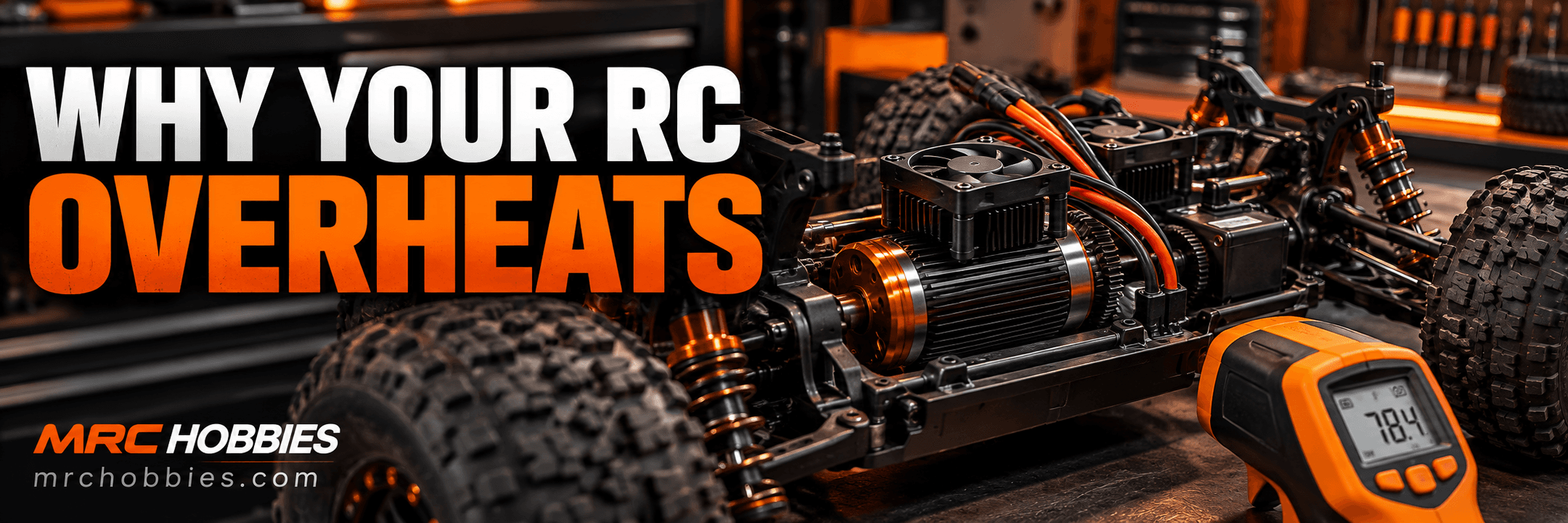
Heat is information about your setup
Electric motors and speed controllers generate heat during operation. However, excessive temperature or repeated thermal shutdown indicates that something needs attention.
The cause may be high operating load, unsuitable gearing, drivetrain resistance, inadequate cooling, or an electrical problem.
Adding a fan without investigating the cause can leave the original issue unresolved.
Start by noting which component becomes hot, how quickly it happens, and what the car is doing at the time.
Terrain changes the load
Grass, loose surfaces, steep climbs, and repeated acceleration can place different demands on the same vehicle.
A car geared for fast runs on a smooth surface may work much harder during stop-start driving through grass. Manufacturer guidance identifies gearing unsuitable for the driving conditions as a major cause of excessive electronics temperature. traxxas.com
Record the surface and driving style when comparing temperatures.
A setup that worked during one type of driving is not automatically suitable for another.
Check recent changes
Did the problem begin after fitting larger tires, changing the pinion, increasing battery voltage, or adding weight?
These changes can alter the power system’s operating conditions.
Return to the approved baseline where practical and compare the result. This is more useful than changing several things simultaneously.
Check the vehicle, motor, and ESC specifications before assuming a new battery or gear combination is supported.
Mechanical resistance creates additional work
A tight gear mesh, damaged bearing, bent shaft, or trapped debris can increase drivetrain resistance.
With the battery disconnected, inspect the drivetrain using the service procedure. Check for unusual stiffness and contamination around shafts and wheel hubs.
Do not force a mechanism that feels jammed.
If necessary, isolate sections of the drivetrain to locate the resistance rather than blaming the motor immediately.
Inspect cooling equipment
Check that cooling openings are clear and that fitted fans operate correctly.
A fan may be obstructed, disconnected, damaged, or supplied with an unsuitable voltage. Heat sinks also need their intended mounting arrangement.
Body covers and additional protective materials can affect airflow. Assess their suitability rather than assuming every cover helps in every condition.
Cooling equipment supports a suitable setup; it does not make unsupported gearing or electrical combinations acceptable.
A useful troubleshooting order
StepCheck1Which component is overheating?2What surface and driving style are involved?3What changed recently?4Is the battery and motor combination approved?5Does the drivetrain move normally?6Are airflow and fans functioning?7What fault code does the ESC report?
This sequence helps avoid unnecessary purchases.
Measure rather than guess
Use an appropriate temperature-measuring method and follow the manufacturer’s limits.
There is no single safe temperature that applies to every motor, ESC, battery, and measurement location.
Infrared thermometers can produce different readings depending on surface finish and measurement technique. Use a consistent location and procedure when comparing runs.
Checking only after a long pause may miss the highest operating temperature.
Shutdown does not always mean overheating
A car that stops or reduces power may be responding to low battery voltage, signal loss, or another fault.
Read the ESC’s indicators and manual. Manufacturer support distinguishes thermal protection from low-voltage protection. traxxas.com
Do not disable protections to test whether the vehicle keeps moving.
Common mistakes to avoid
Avoid fitting a bigger fan as the only response, repeatedly restarting after thermal shutdown, or assuming hand-touch checks establish a safe temperature.
Also avoid changing gearing, timing, tires, and cooling together. Keep your diagnosis traceable.
Final thoughts
Overheating is a reason to inspect load, gearing, mechanical condition, and cooling.
Find the cause first, make a controlled change, and test briefly within the manufacturer’s limits.
Shop: MRC Hobbies
Visit: MRC Hobbies, 201, P. N. Kothari Industrial Estate, next to Navkar Hospital, Bhandup West, Mumbai, Maharashtra 400078
Phone / WhatsApp: +91 77840 93093
Instagram: @mrchobbies
YouTube: MRC Hobbies