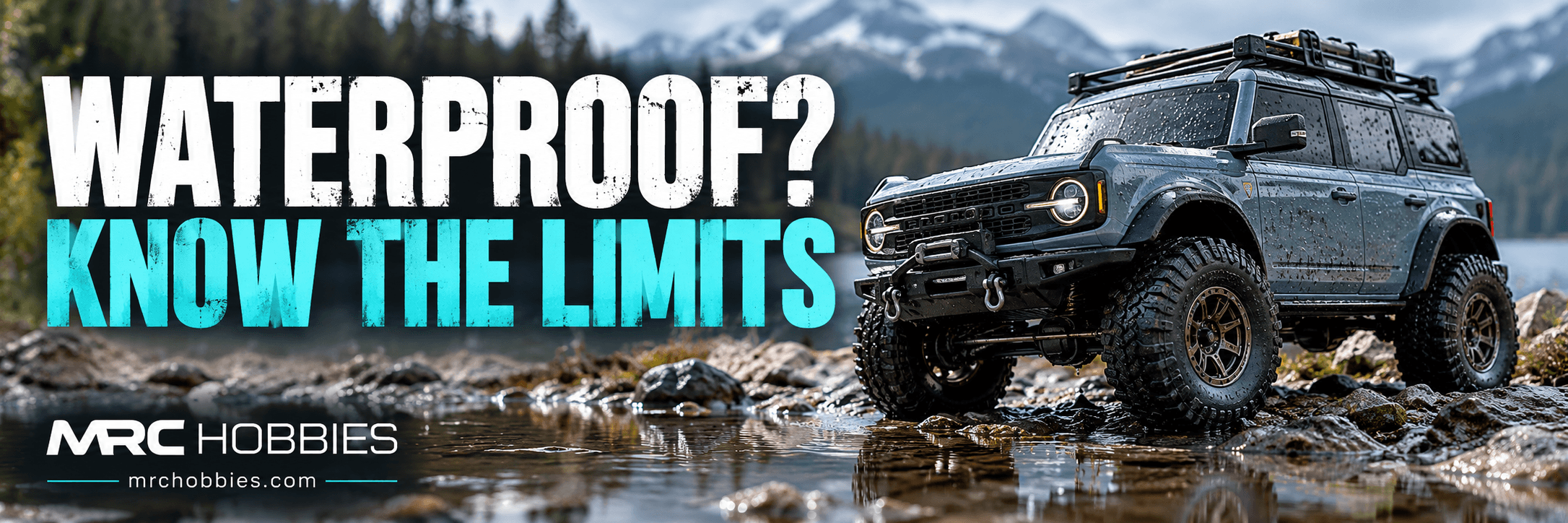
A protected component does not describe the whole vehicle
An RC car may advertise a waterproof servo or ESC. That does not establish that every part of the vehicle can tolerate the same exposure.
The receiver, battery, connectors, bearings, drivetrain, tires, and body can have different requirements.
The practical starting point is the complete vehicle manual, followed by the instructions for any replacement electronics.
Do not treat a single label as permission to submerge the entire car.
What water resistance means in practice
Water-resistance claims need context.
Check which component is protected, what conditions are permitted, and which installation requirements maintain that protection.
A receiver box may rely on correctly fitted seals and properly routed wires. A protected ESC may have a fan with different limitations.
If a formal protection rating is provided, read its meaning and the manufacturer’s application instructions rather than relying on the number alone.
Different exposures create different problems
Light splashes, rain, deep water, and muddy water are not equivalent.
Duration, depth, contamination, and the condition of seals all influence exposure.
Even when wet driving is permitted, water can reach mechanical components that need additional maintenance afterward.
A car running normally immediately after a splash does not prove that no moisture remains inside it.
Areas to inspect
Area What to check ESC and servoIndividual protection claims and installation requirementsReceiver enclosureSeals, wire routing, lid, and damageBattery and connectorsManufacturer’s permitted exposure and drying procedureBearings and shaftsMoisture, corrosion, contaminationWheels and tiresTrapped water and insert conditionGearboxesModel-specific post-wet service requirements
Treat these as separate checks.
Inspect protection before wet driving
Look for damaged seals, loose enclosure screws, cracked housings, and modifications that affect protection.
An incorrectly refitted receiver-box lid can compromise the intended sealing arrangement.
Check cables and connectors for damage. Confirm that any added lights, fans, or accessories are suitable for the same conditions.
Only operate within the complete vehicle’s permitted limits.
After permitted wet use
Follow the manufacturer’s cleaning and drying procedure.
Remove the battery as instructed, clear contamination, and inspect the vehicle before storage.
Some models permit low-pressure rinsing under specified conditions; others require different cleaning methods. Do not generalise one model’s instructions to every RC car.
For example, the Traxxas Sledge manual specifies additional maintenance after wet running, including attention to bearings and moisture in mechanical components. traxxas.com
Do not overlook tires and inserts
Water may enter vented wheels or tires and remain in the inserts.
Follow the model’s draining and drying procedure. Avoid improvising high-speed wheel spinning, which can create additional risks and damage.
Unevenly retained water can also affect the rotating assembly.
Check the tires before putting the vehicle away rather than focusing only on electronics.
Fresh water and salt water
Do not assume permission for one type of exposure covers another.
Salt water introduces additional corrosion and electrical concerns. Dirty water can carry grit into mechanical assemblies.
Unless the manufacturer explicitly permits the conditions and provides a suitable care procedure, choose a different driving area.
A protective coating or general-purpose spray does not automatically make unsupported use acceptable.
What if the car was unexpectedly submerged?
Stop operating it and follow the manufacturer’s recovery instructions.
Do not immediately reconnect the battery simply to see whether it works.
Inspect electronics, connectors, battery condition, and mechanical assemblies using the appropriate procedure. Seek service assistance where the instructions or condition require it.
Dry-looking external surfaces do not establish that internal areas are dry.
Common mistakes to avoid
Avoid treating waterproof electronics as a maintenance-free vehicle, storing the car while wet, and using a pressure washer without approval.
Do not assume a replacement fan or accessory inherits the original component’s protection.
Also avoid relying on online videos as evidence that your model is suitable for submersion.
Final thoughts
Water protection is specific to components, installation, and operating conditions.
Read the complete vehicle instructions, inspect protection before use, and complete the required care afterward. Staying within those limits helps preserve both electronics and mechanical parts.
Shop: MRC Hobbies
Visit: MRC Hobbies, 201, P. N. Kothari Industrial Estate, next to Navkar Hospital, Bhandup West, Mumbai, Maharashtra 400078
Phone / WhatsApp: +91 77840 93093
Instagram: @mrchobbies
YouTube: MRC Hobbies