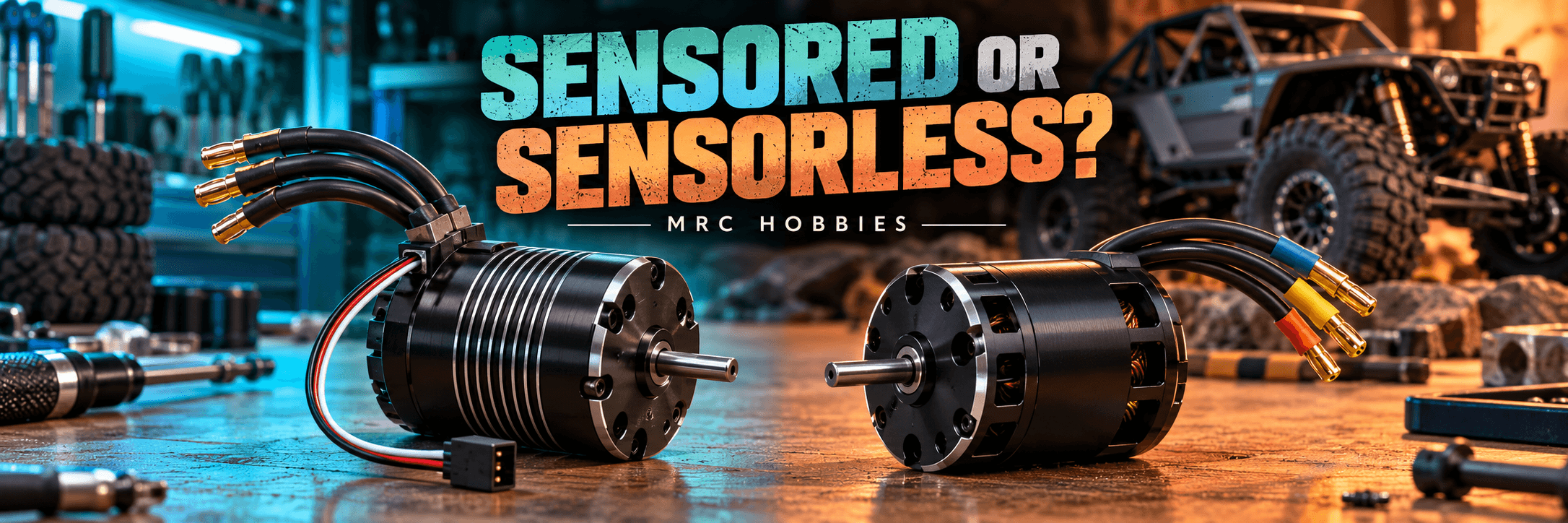
Why two brushless cars can feel different
A brushless motor can give an RC car impressive performance, but the word brushless does not tell the whole story. One car may move smoothly the moment you touch the throttle, while another needs a little more input before it starts cleanly. The motor, ESC, gearing, and programming all influence this behaviour. One important choice is whether the system uses rotor-position sensors.
A sensored system gives a compatible ESC position information from the motor. A sensorless system estimates rotor position using electrical feedback while the motor operates. Both can be excellent when matched to the car and the job. Castle Creations describes sensored and sensorless operating modes.
What is a sensored brushless system?
A sensored motor has a sensor connection in addition to its three main motor wires. With a compatible sensored ESC and cable, the controller can use rotor-position feedback to manage startup and low-speed operation. This is particularly appealing when a crawler needs to move a few millimetres without a sudden jump. It can also help a driver who wants predictable response when accelerating out of a corner.
The cable and sensors add components to install and inspect. A sensored motor does not guarantee perfect control by itself: ESC tuning, gearing, throttle settings, and mechanical drag remain important.
What is a sensorless brushless system?
A sensorless setup has the usual three motor connections without a separate rotor-position sensor lead. The ESC uses the motor's electrical behaviour to determine when to switch the windings. This can offer simple wiring and strong performance for fast bashing or racing. At extremely low speed, some combinations may hesitate or feel less smooth, although the result varies substantially by ESC and motor design. Castle describes its Sidewinder range as sensorless systems.
Side-by-side comparison
FeatureSensored brushlessSensorless brushlessRotor informationPhysical sensor feedback to a compatible ESCEstimated electronically by the ESCVery low-speed startupOften an advantage for precise controlDepends strongly on the system and tuningWiringThree power wires plus sensor leadThree power wiresSetup checksMotor and ESC sensor compatibility, cable routing, and settingsMotor and ESC ratings, calibration, and settingsTypical appealCrawling and predictable low-speed responseStraightforward installation and fast drivingCostDepends on products; often more equipment featuresDepends on products; can be a simpler entry point
These are tendencies, not a ranking of every product. Some advanced systems use the sensor at startup and change operating mode as speed rises. Read the precise motor and ESC manuals before assuming how a combo behaves. Castle lists multiple modes on a sensored motor.
Which works better for crawling, racing, or bashing?
For technical crawling, controlled startup is often more important than top speed. A well-matched sensored setup may make it easier to hold a line on rocks. For casual bashing, a suitable sensorless system may give all the punch and responsiveness you want without an extra cable. For racing, both categories contain capable products; the car class, track surface, ESC tuning, and driver preference determine the best fit.
A useful test is to watch the car launch slowly on the surface you actually use. Look for smooth movement, predictable throttle, and reasonable temperatures after driving. A specification alone cannot show the whole driving feel.
Compatibility checklist before upgrading
- Confirm that the ESC supports the chosen motor type and operating mode.
- Check motor size, mounting pattern, shaft diameter, and pinion fit.
- Check the allowed battery voltage and vehicle weight or application guidance for the complete combo.
- For a sensored setup, confirm sensor-cable and connector compatibility and route the cable clear of moving parts.
- Start with conservative gearing and check temperatures against the manufacturers' limits.
- Calibrate the ESC and transmitter according to the ESC manual.
A sensored motor connected to a sensorless ESC may be usable in sensorless mode only if the manufacturer permits that combination. The presence of a sensor port does not make every motor and ESC pairing compatible.
Common problems and what to inspect
Jerky startup can come from sensor wiring, an incorrect ESC setting, gearing that loads the motor heavily, a dragging drivetrain, or a weak connection. If a car behaves differently after an upgrade, change one thing at a time and check the manuals. Do not repeatedly force a stalled drivetrain with throttle.
Example: choosing a motor for a trail crawler
Imagine that you drive a scale crawler over rocks and narrow bridges. You regularly need to start from a complete stop while a tire is pressed against an obstacle. Your priority is not a dramatic burst of speed; it is a smooth first movement and a throttle response you can repeat. A compatible sensored motor and ESC can be worth considering here. But compare actual combinations, because a poorly geared or badly programmed sensored car can still feel abrupt.
Now imagine a buggy that spends most of its time accelerating across an open dirt area. You may care more about a robust, well-matched power system and comfortable trigger response at driving speed. A suitable sensorless combo can do that job well. The decision changes with the vehicle and the driver rather than following one universal rule.
How to evaluate a system in the shop
Ask for the motor and ESC model numbers and look up the combination's battery and application limits. Identify whether a sensor cable is included and whether both devices support its use. If the system is installed in a demonstration car, watch a very slow start, a controlled mid-speed run, and a stop. Notice whether the car responds consistently each time. Ask about spare sensor cables, motor bearings, and service support for the specific system.
Common buying mistakes
- Buying a sensored motor while retaining an ESC that cannot use its sensor feedback, then expecting a sensored driving feel.
- Comparing systems solely by Kv and ignoring motor size, vehicle weight, gearing, and battery voltage.
- Assuming sensorless means unsuitable for every crawler or sensored means automatically faster on a straight.
- Installing a cable where a tire, driveshaft, or gear can damage it.
Final thoughts
Choose sensored when low-speed precision and controlled starts are central to your driving. Choose sensorless when a simpler connection and the feel of a well-matched system suit your car. The motor, ESC, battery, gearing, and vehicle must work together.
Explore RC cars and electronics: MRC Hobbies
Visit: MRC Hobbies, 201, P. N. Kothari Industrial Estate, next to Navkar Hospital, Bhandup West, Mumbai, Maharashtra 400078
WhatsApp: +91 77840 93093
Instagram: @mrchobbies
YouTube: MRC Hobbies