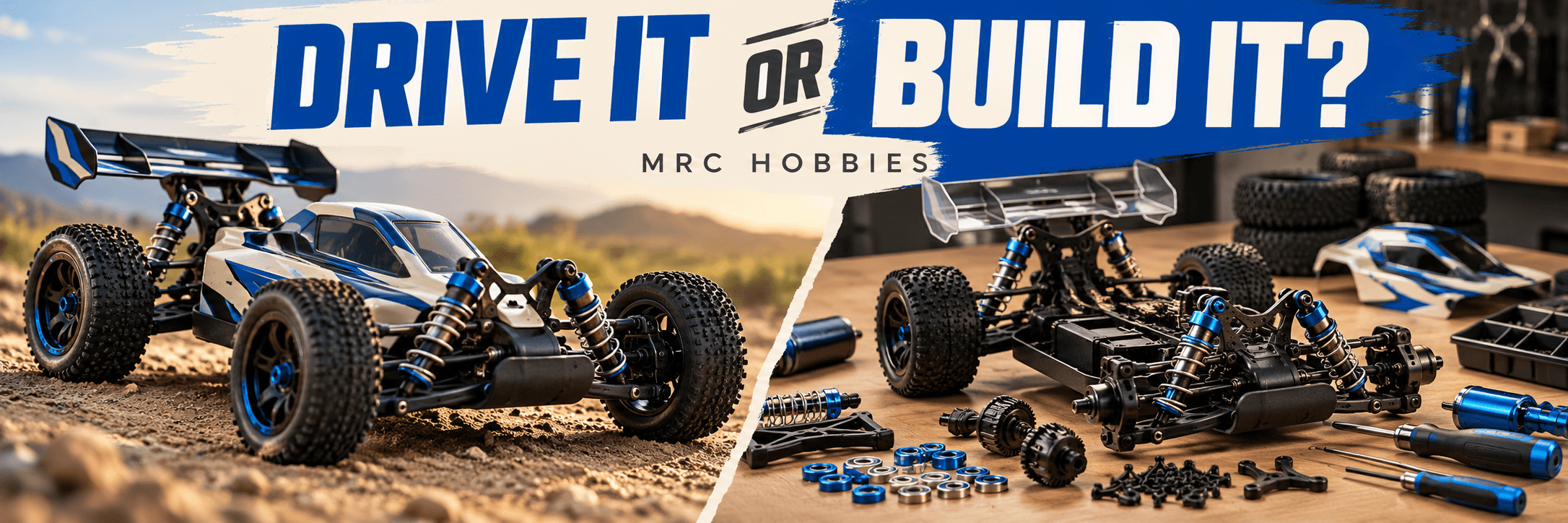
Two ways to enter the RC hobby
Do you want to open the box and head for a driving spot, or do you want to understand every screw before the first run? That is the central choice between a ready-to-run (RTR) RC car and a build kit. Both can lead to an excellent hobby experience, but they differ in time, planning, and what you may need to buy separately.
The labels are not universal promises about box contents. A Kyosho Readyset example still requires a drive battery and transmitter batteries. A Kyosho KB10W kit lists radio gear, ESC, motor, and battery among its additional requirements. Always read the particular product's included and required-items lists.
What is an RTR or Readyset RC car?
An RTR car arrives largely assembled with a matched set of installed electronics, often including a transmitter and receiver. You still need to inspect it, charge the appropriate battery, prepare the radio, and follow its setup instructions. Some boxes contain a drive battery and charger; others do not. “Ready” describes the assembly state more than a guarantee that nothing else is needed.
RTR is a strong choice when your goal is to drive soon. You can still learn the mechanical side through cleaning, changing tires, tuning, and repairs.
What is an RC kit?
A kit makes assembly a central part of the experience. Depending on the product, you may build most of the chassis, or some complex assemblies may arrive prebuilt. Kyosho says its KB10W kit includes prebuilt front, centre, and rear gearboxes even though it is a kit. You may need to choose and install the radio, servo, ESC, motor, battery, wheels, or body finishing supplies. The exact list is model-specific.
A kit can teach how the suspension, steering, and drivetrain fit together. It also lets you select components from the outset, but choosing compatible parts takes time and attention.
RTR vs kit comparison
QuestionRTR / ReadysetBuild kitTime until the first driveUsually shorter after setup and chargingAssembly and setup take additional timeElectronicsCommonly preselected and installedMay need to be purchased and installed separatelyLearning routeDrive first, learn through maintenance and upgradesLearn construction while buildingComponent choiceStart with supplied setupSelect parts to suit goals and kit requirementsBudget clarityCheck missing batteries, charger, and accessoriesPrice the kit plus all required parts and toolsBest forSomeone eager to drive promptlySomeone who enjoys building and setup
Calculate the real cost
The box price alone is a poor comparison. For either option, write down the required drive battery, charger, transmitter batteries, tools, tires, body paint, glue, oils, and other consumables listed by the maker. Do not buy a component because a similar kit needed it; read the exact kit version's manual and completion guide. Include replacement-part availability in the decision.
Questions to ask before buying
- Which parts and electronics are already inside the box?
- What is explicitly listed as required for operation?
- Are the battery connector, charger, ESC, and motor compatible?
- Does the body arrive finished, or must it be painted or mounted?
- What tools and assembly skills are needed?
- Can you obtain spare parts for this exact chassis?
- Would you enjoy spending your first weekend building, or would you rather drive?
A useful first-weekend plan
For an RTR car, read the manual, check the steering and wheel hardware, charge correctly, and begin in an open area at a controlled speed. For a kit, sort the parts, work in stages, keep small screws in labelled containers, and test each mechanical assembly before hiding it under the body. Both owners should keep the manual for later repairs.
Example: compare two complete shopping lists
Suppose an RTR box contains the assembled car and radio but needs a drive battery and charger. The effective purchase includes those items plus any required transmitter batteries. A kit at a similar sticker price might need the radio, receiver, steering servo, ESC, motor, battery, charger, and perhaps body paint. The two sticker prices are not comparable until you total every required item.
A kit can still be the better value for someone who wants those specific components and enjoys building. An RTR can be the better value for someone who wants to drive quickly with a matched factory setup. The aim is to make the cost and the experience visible before buying.
What you learn from each route
With RTR, your early lessons come from driving lines, battery care, cleaning, and the first repair. With a kit, you learn where every linkage and gear belongs as you assemble it, though the first drive comes later. Both routes lead to technical understanding if you stay curious. A kit owner should not rush assembly just to finish; an RTR owner should not skip the manual because the car arrived assembled.
Common buying mistakes
- Assuming the words “ready to run” mean the drive battery and charger are always in the box.
- Buying a kit without pricing its radio, electronics, tools, and finishing supplies.
- Ordering a battery with the wrong connector, dimensions, or voltage for the vehicle.
- Choosing a kit solely for customization when the actual goal is to drive that weekend.
- Forgetting to check spare parts and the clarity of the assembly instructions.
Final thoughts
Choose RTR when driving immediately is the main attraction. Choose a kit when the assembly journey is part of the fun and you want to choose the setup. The best purchase is the complete, affordable project you will continue to enjoy after the first run.
Explore RC cars, kits, and accessories: MRC Hobbies
Visit: MRC Hobbies, 201, P. N. Kothari Industrial Estate, next to Navkar Hospital, Bhandup West, Mumbai, Maharashtra 400078
WhatsApp: +91 77840 93093
Instagram: @mrchobbies
YouTube: MRC Hobbies