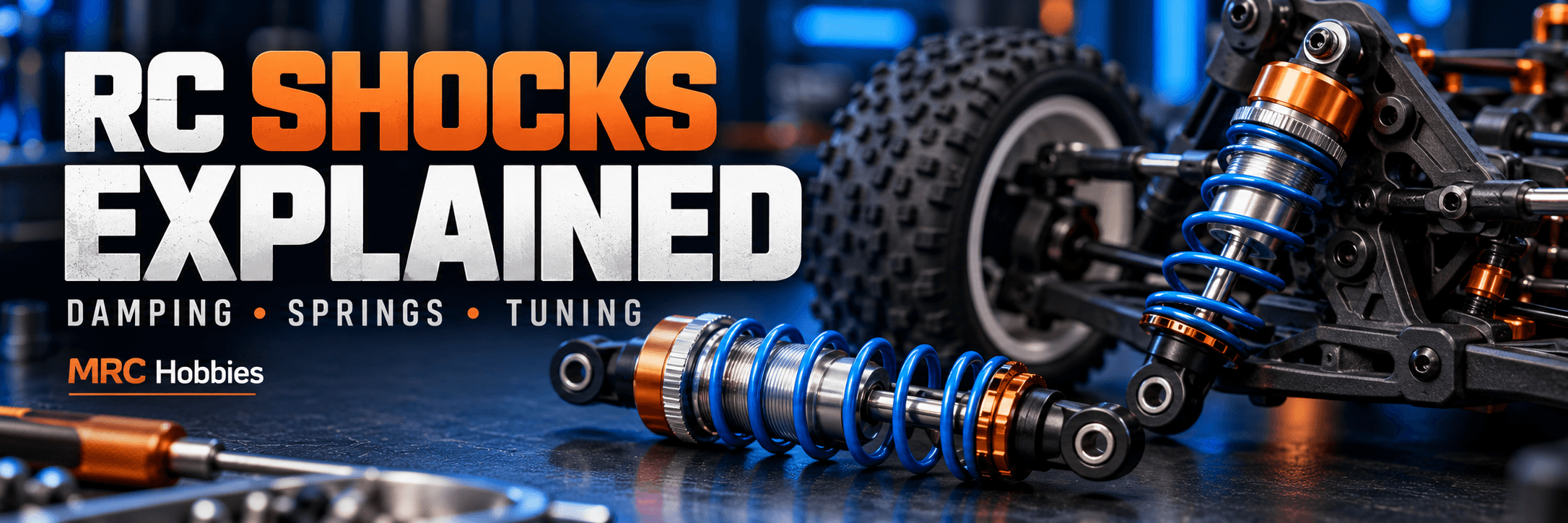
Two RC cars with similar motors and tyres can feel very different on the same surface. One settles quickly after a bump, while the other keeps bouncing. One follows uneven ground confidently, while the other skips across it. Suspension setup is part of that difference.
RC shocks help control how the suspension moves. They affect the car’s response to bumps, acceleration, braking and landings. Understanding them makes it easier to diagnose handling problems and choose useful adjustments.
A good setup starts with knowing what the springs do, what the dampers do and how the complete suspension works together.
1. What Do RC Shocks Actually Do?
Most familiar RC coilover assemblies combine a spring with a damper.
The spring supports the vehicle and stores energy as the suspension compresses. The damper resists movement and dissipates energy, helping control how quickly the suspension compresses and extends.
Without enough damping, the car may continue bouncing after a disturbance. Too much damping can stop the wheels following rapid surface changes effectively. The goal is controlled movement rather than the stiffest suspension possible.
Shocks work alongside tyres, suspension arms, links, mounting geometry and chassis weight. They cannot compensate for a bent arm, binding linkage or badly matched tyres.
2. Inside an Oil-Filled RC Shock
An oil-filled damper contains a piston attached to a shaft. As the suspension moves, the piston travels through the oil. Oil flows through passages in or around the piston, creating resistance to movement. traxxas.com
Its main components include:
- Shock body: Holds the oil and guides the piston.
- Shock shaft: Connects suspension movement to the piston.
- Piston: Controls oil flow together with its passages.
- Seals: Help retain oil around the moving shaft.
- Spring: Supports the vehicle.
- Cap and volume-compensation arrangement: Close the damper and accommodate shaft displacement.
Different designs use different filling and bleeding procedures. Not every part advertised as an RC shock is oil-filled; some inexpensive models use spring-only assemblies or friction damping.
Confirm the design before buying oil or attempting a rebuild.
3. Springs and Damping Are Different Adjustments
Spring rate describes how much additional force is needed to compress a spring further. A higher-rate spring resists compression more strongly than a lower-rate spring over the same movement.
Damping controls motion. It does not replace the spring’s job of supporting the car.
A vehicle that sits too low may need its ride height and spring choice checked. Thicker oil alone does not solve static sag.
Likewise, repeated bouncing does not automatically mean a harder spring is required. Check damping, oil condition, air in the damper and mechanical freedom first.
Understanding this distinction prevents adjustments that hide one problem while creating another.
4. Shock Oil: What Does Thickness Change?
With the same shock, piston and operating conditions, higher-viscosity oil generally increases damping resistance. Lower-viscosity oil generally allows quicker movement.
The piston matters too. Associated Electrics’ technical information shows how changes to piston passage geometry can change fluid flow and resistance during fast impacts. Associated Electrics
Shock oil is commonly labelled in cSt or weight ratings such as wt. Do not assume an identical wt label from two brands represents exactly the same viscosity.
There is no universal oil specification for every 1/10 car or every crawler. Vehicle mass, suspension geometry, piston design, terrain and driving style all matter.
Start with the manufacturer’s recommended fluid and specification. Many hobby dampers use silicone shock oil; Traxxas, for example, specifies silicone oil for its shocks. traxxas.com
5. Preload: Adjusting Ride Height
Threaded collars or clip-on spacers compress the spring before additional suspension movement occurs. This is spring preload.
Within the available adjustment range, preload changes how the vehicle sits under its weight. For a conventional linear spring, adding preload does not change the spring’s underlying rate. It changes its initial compression and the suspension’s resting position.
Excessive preload can leave too little extension travel for a wheel to follow a dip. If the correct ride height requires extreme adjustment, investigate spring suitability, vehicle weight and suspension geometry.
Set ride height with the normal battery and equipment installed. An empty chassis may sit differently from the car you actually drive.
6. Shock Position and Suspension Geometry
Moving a shock to a different mounting hole changes its relationship to wheel movement. This can alter effective stiffness, damping and available travel. The result depends on the suspension design and whether the upper or lower mount changes. traxxas.com
Avoid treating “upright is better” or “laid down is softer” as complete tuning rules.
After changing the mounting position, check:
- Ride height.
- Compression and extension travel.
- Tyre and body clearance.
- Driveshaft movement.
- Whether the shock or linkage binds.
A shock must not force another component beyond its intended range.
7. Different RC Categories Need Different Priorities
RC categorySuspension priorityWhat to watchCrawlersControlled articulation and stabilityExcessive ride height, body movement and bindingBuggies and race trucksRepeatable response through bumps and cornersTyre contact, balance and landing recoveryMonster trucksControlled rough-ground movement and landingsRepeated bouncing, damage and unsuitable jumpsOn-road and drift carsPredictable chassis movement on the intended surfaceRide height, clearance and consistent response
A crawler does not automatically improve with the longest shocks. Extra travel can create clearance problems and reduce stability.
A race car does not automatically improve with the thickest oil either. The setup must suit the whole vehicle and the surface being driven.
8. A Simple Method for Tuning RC Shocks
Start with the manufacturer’s setup and use a repeatable process:
- Inspect first. Check shafts, seals, mounting hardware and suspension freedom.
- Record the baseline. Note oil, springs, mounting positions and ride height.
- Describe the problem. Identify whether it happens over small bumps, in corners, under braking or during landings.
- Change one variable. Make a small adjustment.
- Repeat the test. Use the same surface, battery position and similar driving inputs.
- Keep or reverse the change. Compare the result and write down what happened.
Unless following a deliberate specialist setup, keep left and right shocks on the same axle matched. Front and rear specifications may legitimately differ.
Changing oil, springs and mounting positions together makes it difficult to identify which adjustment helped.
9. Troubleshooting Common Problems
The Car Keeps Bouncing
Inspect damping consistency, leaks and air in the shocks. Spring choice and tyres can also contribute.
The Car Skips Over Small Bumps
Check for binding and excessive damping. Increasing stiffness may make the problem worse by preventing the wheels from following the surface.
The Chassis Bottoms Frequently
Review ride height, springs, damping, bump stops and the size of the obstacle. Some chassis contact can occur in normal use; severe landings cannot always be solved by shock tuning.
One Corner Sits Lower
Compare preload, spring seating, shock condition and mounting points. Check weight distribution and damaged suspension parts too.
A Shock Feels Stiff or Gritty
Inspect the shaft and seals rather than immediately changing oil. Dirt or a bent shaft can interfere with movement.
These symptoms are starting points for inspection, rather than guaranteed diagnoses.
10. Shock Maintenance and Rebuilding
Clean dirt from exposed shafts and inspect for scratches, bends and oil leakage. Also check loose caps, damaged rod ends and spring retainers.
A film of dirt around a seal deserves inspection, but assess whether oil is actually escaping before assuming a major failure.
When rebuilding, use the model’s instructions for oil level, bleeding, seals and cap installation. Move the piston as directed and allow trapped bubbles to clear. Different shock designs require different rebound settings and closing procedures.
Do not grip the polished working surface of a shaft with ordinary pliers. Damage there can wear the seals and cause leakage. Use suitable tools and avoid overtightening components.
After assembly, check paired shocks for smooth, comparable movement. Replace damaged components rather than expecting fresh oil to repair them.
11. What to Check Before Upgrading
Before purchasing replacement shocks, confirm:
- Extended and compressed lengths.
- Mounting dimensions.
- Shaft travel.
- Spring options.
- Clearance throughout suspension movement.
- Availability of seals and replacement parts.
Scale alone does not establish compatibility.
Aluminium bodies, larger oil volume and rebuildable seals can offer useful features, but material or colour alone does not guarantee better handling.
A correctly matched factory shock can work better than an attractive replacement with unsuitable dimensions. Identify the problem the upgrade should solve: consistency, serviceability and a suitable spring range are practical reasons to upgrade.
Final Thoughts
RC shocks make more sense when their jobs are separated: springs support the car, damping controls movement, and geometry determines how those forces reach the wheels.
Begin with a mechanically sound suspension and a known baseline. Make small changes, test them consistently and keep notes. The right setup helps the car settle predictably and follow the terrain you actually drive.
Explore RC Parts and Accessories with MRC Hobbies
Looking for parts for your RC car? Explore models and accessories at MRC Hobbies. Share your exact model and version when asking about compatible shocks, springs or maintenance parts.
Address: 201, P. N. Kothari Industrial Estate, next to Navkar Hospital, Bhandup West, Mumbai, Maharashtra 400078.
Phone / WhatsApp: +91 77840 93093
Website: mrchobbies.com
Instagram: @mrchobbies
YouTube: MRC Hobbies