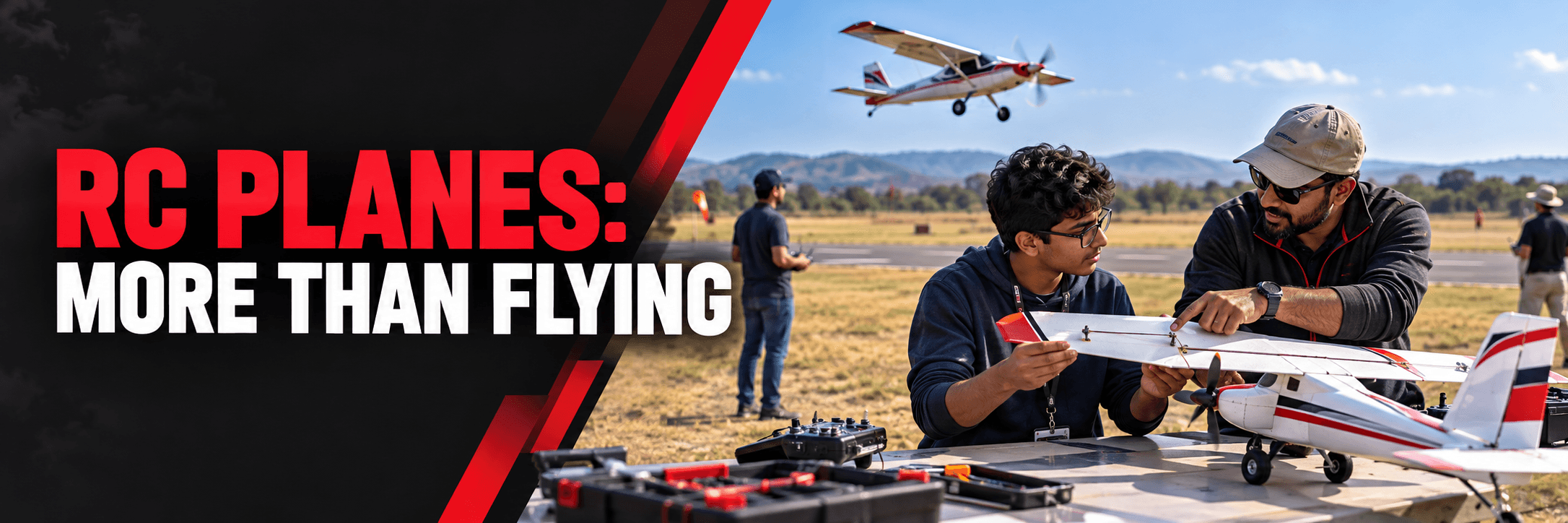
There is a special feeling when an RC plane lifts off for the first time. A model you prepared on a workbench is suddenly flying through open space, responding to the movements of your hands.
That experience draws people into aeromodelling. What keeps them interested is everything that comes with it: understanding why an aircraft flies, learning to control it, solving problems on the ground, and sharing the experience with other enthusiasts.
How does an RC plane fly?
An aircraft in flight is affected by four forces: lift, weight, thrust, and drag. The wings generate most of the lift as the plane moves through the air. Weight acts downward, thrust moves the plane forward, and drag resists its movement. A change in speed, balance, or the aircraft’s position changes how it behaves.
With an RC plane, these ideas become visible. You can watch how it climbs, turns, glides, and descends. You also begin to understand why its balance and control surfaces matter. Aeromodelling gives you a way to connect what you read about aviation with what you observe in the air.
What can you learn from the hobby?
Aircraft design
Look closely at different RC planes and you’ll see that they are built for different experiences. A stable trainer, a glider, and an aerobatic model do not look or behave the same way. Their wings, weight, power systems, and controls reflect what their builders want them to do.
You can start by learning the purpose of each part: the wing, fuselage, tail, motor, propeller, and movable control surfaces. Later, you can explore how design choices affect handling.
Electronics and mechanics
An RC plane brings several systems together. The transmitter sends your commands; the receiver passes them to the appropriate components; servos move control surfaces; and the power system provides energy for flight.
Inspecting and maintaining those systems develops practical skills. You learn to check connections, recognise damage, replace a worn part, and work through a problem methodically.
Preparation and judgement
Flying well involves more than moving the sticks. Before a session, you need to consider the condition of the aircraft, the available space, wind, other people nearby, and how you will bring the plane back safely.
After a flight, you can review what happened. Did you make a turn too sharply? Was your approach to landing rushed? What should you practise next time? That habit of preparing, observing, and improving is one of the hobby’s most useful lessons.
Which type of RC plane should you explore?
Trainer aircraft are designed around approachable handling and are a sensible category to investigate first. Compare the model’s size, control features, included equipment, and the space it needs before choosing one.
Gliders appeal to people who enjoy smooth, unhurried flight. They are also an interesting way to learn about lift, drag, and efficient flying.
Scale aircraft recreate the appearance of real planes. They appeal to aviation fans who enjoy both flight and the details of a particular aircraft.
Aerobatic aircraft are intended for pilots who want to practise more demanding manoeuvres. They are a goal to work towards once you have built a reliable foundation with basic flight control.
The model that looks most exciting in a photograph may not be the best first one. Choose according to your experience, flying area, and the support available to you.
Can RC planes help students learn?
Yes. Aeromodelling can make a classroom lesson more tangible. Students can identify the parts of an aircraft, compare simple wing designs, build a lightweight glider, or observe how a control surface changes a model’s movement.
A good learning activity begins with a question: What do we think will happen if we change this? Students make a prediction, test it where appropriate, and discuss the result. That approach introduces aviation while developing curiosity, teamwork, and problem-solving.
NASA also provides educational material on the forces of flight that can help explain the ideas behind these activities.
Where can the skills lead?
For some people, RC aviation remains a rewarding weekend hobby. Others become interested in aircraft design, electronics, model building, teaching, photography, or more advanced unmanned systems.
An RC plane does not replace professional aviation training. It can, however, help you discover which part of aviation fascinates you. Perhaps you love understanding how wings work. Perhaps you enjoy building reliable systems. Perhaps your favourite part is teaching someone else their first lesson about flight.
A sensible path for beginners
Start by learning the basic parts of a plane and what its controls do. Then choose a beginner-suitable model and understand exactly what equipment it includes. Before flying, find a suitable location, check the applicable local requirements, and inspect the aircraft according to its instructions.
If you can, learn with an experienced flyer or aeromodelling group. Practise basic, controlled flight before trying more demanding manoeuvres. Keep notes after each session: what felt comfortable, what was difficult, and what you want to improve.
There is no need to rush. Every careful flight gives you more understanding and confidence.
Begin your aviation journey
RC planes combine the excitement of flight with the satisfaction of making something work. You can fly, build, study aircraft, create content, or introduce someone else to the wonder of aviation. Each part of the hobby offers a new reason to return to the flying field.
Explore RC planes and aeromodelling supplies at MRC Hobbies.