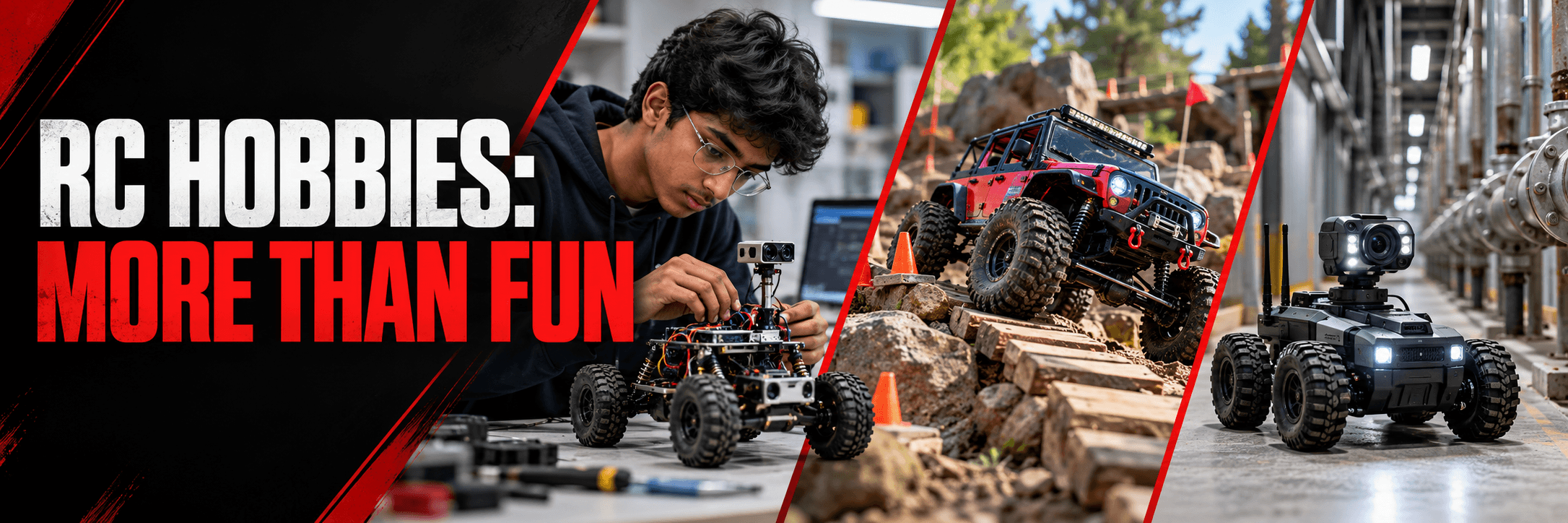
For many people, the RC hobby begins with a simple moment: picking up a controller and watching a vehicle respond. It might be a car taking its first corner, a crawler climbing an obstacle, or a plane making a smooth pass overhead.
The fun is reason enough to start. But as you spend more time with RC models, you discover something else: they give you a hands-on way to learn, create, solve problems, and connect with people. The same basic ideas behind an RC car—power, control, movement, and feedback—can become the starting point for much bigger projects.
1. Make engineering easier to understand
A working RC model puts engineering concepts where you can see them. Change a tyre and you may notice a difference in grip. Adjust a suspension setup and you can see how the vehicle handles uneven ground. Build a small rover and you learn how a motor, controller, battery, and chassis work together.
That makes RC useful for students and curious adults alike. Instead of only reading about a mechanism, you can build it, test it, find a problem, and improve it. A simple school challenge—such as making a rover complete an obstacle course—can introduce mechanical design, electronics, teamwork, and troubleshooting in one activity.
2. Develop practical repair skills
Using an RC vehicle teaches you to notice when something changes. Perhaps a wheel no longer spins freely, steering pulls to one side, or a connector has become loose. Finding the cause takes observation and a step-by-step approach.
Learning to inspect, clean, maintain, and repair a model builds confidence with tools and components. It can also keep a vehicle running longer. For some hobbyists, fixing a problem becomes as satisfying as the next drive.
3. Bring people together through events
An RC event can turn individual interest into a shared experience. Beginners get to see different vehicles in action and ask questions. Experienced drivers can practise, compete, and exchange ideas.
Events can take many forms: a timed race, a crawler challenge, a beginner driving session, or a hands-on robotics workshop. They can work well for hobby groups, schools, colleges, and public events because spectators can see what is happening immediately—and participants get a turn to try.
Interested in experiencing the community firsthand? Explore MRC Hobbies events.
4. Create distinctive photos and videos
RC models give creators a different point of view. A low camera angle can make a small crawler route feel like a full-size off-road trail. A scale model can become part of a detailed miniature scene. Racing footage can show speed, close competition, and the skill of the driver.
Creating RC content also develops useful skills of its own: planning a shot, setting up a safe driving area, lighting a scene, editing video, and telling a story. It is a hobby that gives you something interesting to make and share.
5. Test ideas for larger robots
An RC platform can serve as a starting point for robotics experiments. A builder might test how a vehicle steers, crosses rough ground, carries a camera, or responds to controls before developing a larger purpose-built machine.
These experiments need careful design. A hobby vehicle is not automatically suitable for demanding industrial work. But testing ideas at a small scale can help a team learn what needs to change before committing to a bigger build.
If building interests you, browse robotics components at MRC Hobbies.
6. Explore purpose-built applications
With the right engineering, testing, and operating procedures, remotely controlled ground vehicles can carry cameras or sensors for specific inspection tasks. They may be useful where a closer view is needed or where equipment has to travel across difficult ground.
The intended job determines the design. Payload, terrain, communication range, reliability, and safety all matter. This is one example of how the skills developed through the RC hobby can lead towards real-world engineering work.
Where should you start?
You don’t need to begin with an ambitious robot. Start with what genuinely interests you. Drive an RC car, try a beginner robotics project, attend an event, or learn to maintain a model you already own. Each experience will show you what you want to explore next.
RC can be a weekend pastime, a creative outlet, a teaching tool, or the beginning of a technical career. Its greatest benefit is that it invites you to try an idea and see what happens in the real world.
Explore RC models, robotics components, and hobby supplies at MRC Hobbies.