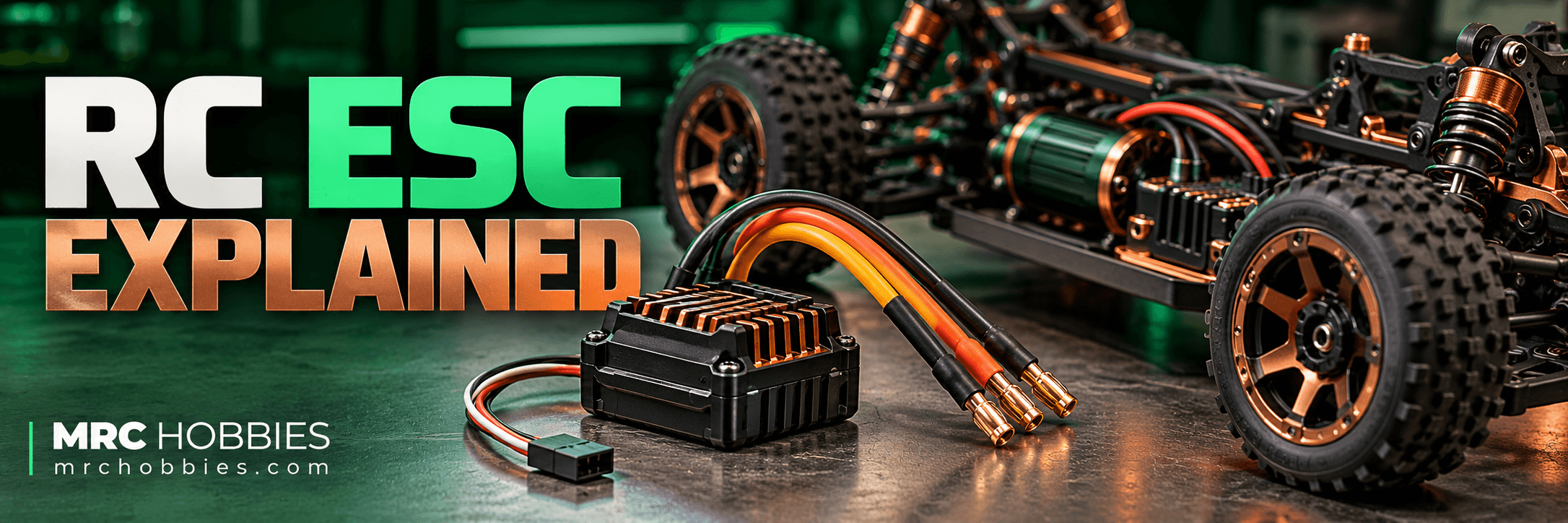
What happens between pulling the trigger and moving the car?
When you press your transmitter’s throttle trigger, the motor does not receive that command directly. The receiver passes the throttle signal to the electronic speed controller, commonly called the ESC.
The ESC controls the electrical power delivered to the motor. Depending on its design, it also manages braking, reverse, battery protection, and other functions.
This makes the ESC an important part of how an electric RC car feels. Two vehicles with similar motors can respond differently because their controllers, settings, and gearing differ.
Understanding the ESC helps you make sensible adjustments and avoid buying an incompatible replacement.
What an ESC does
The ESC receives power from the battery and a control signal from the receiver. It then switches electrical power to operate the motor.
A brushed ESC and a brushless ESC handle their motors differently. A conventional brushed motor usually has two power connections, while a conventional three-phase brushless motor has three.
Some ESCs support additional motor types or operating modes, but that must be confirmed in the specifications.
Many ESCs also incorporate a battery eliminator circuit, or BEC, which supplies regulated power to the receiver and servo. Its voltage and current capability matter when selecting electronics.
Brushed and brushless ESCs
FeatureBrushed ESCBrushless ESCTypical motor connectionsTwoThreeMotor compatibilitySpecified brushed motorsSpecified brushless motorsSensor connectionGenerally absentPresent on suitable sensored systemsSelection checksBattery limits, motor limits, BECBattery limits, motor limits, sensor support, BEC
Do not assume an ESC works with a motor simply because both fit inside the chassis. Electrical compatibility comes first.
What the current rating tells you
An ESC may be advertised with a current rating, but that number should not be used alone.
Voltage limits, motor restrictions, cooling conditions, vehicle weight, and the manufacturer’s intended application all matter. Continuous and burst ratings also describe different conditions.
A controller suitable for a lightweight road car may be inappropriate for a heavy truck working through grass.
Choose a system approved for your motor, battery, and vehicle application rather than selecting the largest number on the label.
Settings worth understanding
Common adjustable settings include throttle response, maximum braking, reverse behaviour, and low-voltage protection.
Some controllers offer drag brake, timing adjustments, or different operating modes. Availability varies between models. Hobbywing manuals, for example, describe model-specific braking behaviour and thermal-protection functions. hobbywing.com
SettingWhat it influencesThrottle response or punchHow abruptly power is appliedMaximum brake strengthBraking command at full brake inputDrag brakeBraking when the trigger returns to neutralRunning modeForward, braking, and reverse sequenceLow-voltage protectionResponse when battery voltage becomes too low
Record the original settings before changing anything.
Why throttle calibration matters
Some ESCs require calibration to recognise the transmitter’s neutral, full-throttle, and full-brake positions.
Incorrect calibration can produce incomplete throttle response or unusual braking behaviour. Follow the ESC’s exact procedure, including the required trim and endpoint settings.
Calibration is different from adjusting the car’s maximum power. If a transmitter setting limits throttle, recalibrating without understanding that setting can change the result.
Do not mix instructions from unrelated controllers.
Troubleshooting before replacing the ESC
If the car loses drive, check the battery, connectors, radio signal, motor connections, and drivetrain condition.
Read the indicator lights or fault codes in the manual. Thermal protection and low-voltage protection can both interrupt driving, but they require different responses.
An ESC that stops supplying power is not automatically faulty.
Common mistakes to avoid
Avoid disabling protection to keep driving, connecting unsupported batteries, or increasing motor timing without understanding the system.
Also check BEC compatibility before fitting a higher-demand servo. An upgraded servo can place additional demands on the receiver’s power supply.
Final thoughts
The ESC controls more than speed. It shapes throttle response, braking, reverse behaviour, and system protection.
Begin with a compatible system, understand its manual, and change one setting at a time.
Shop: MRC Hobbies
Visit: MRC Hobbies, 201, P. N. Kothari Industrial Estate, next to Navkar Hospital, Bhandup West, Mumbai, Maharashtra 400078
Phone / WhatsApp: +91 77840 93093
Instagram: @mrchobbies
YouTube: MRC Hobbies