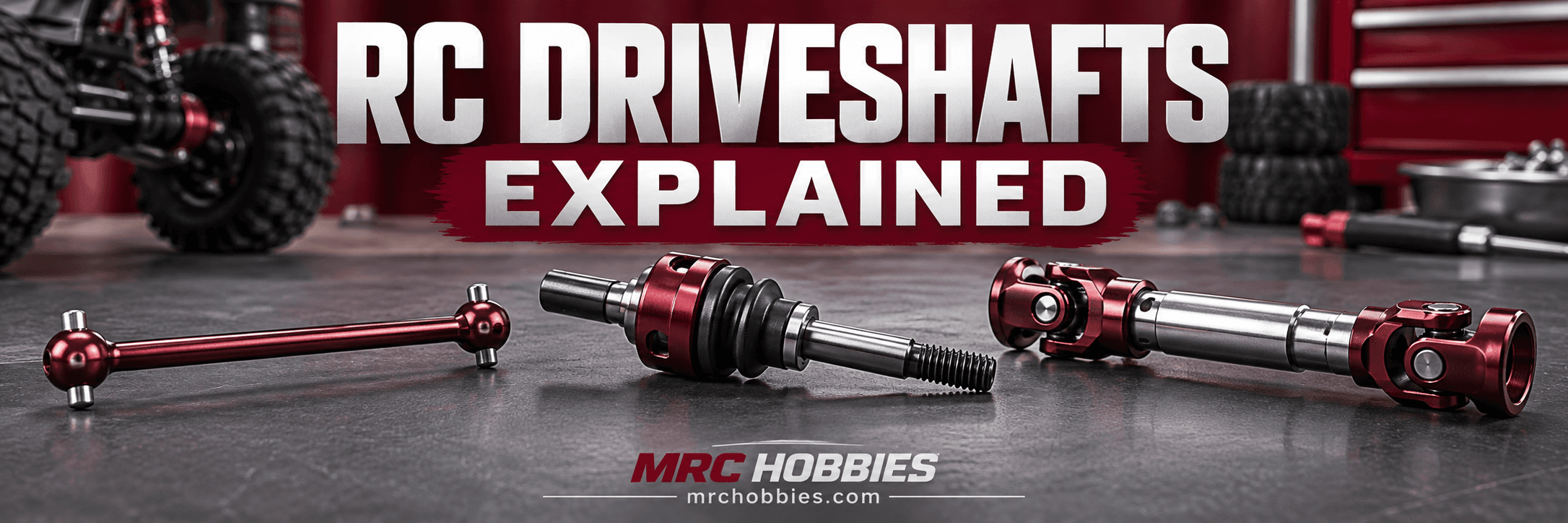
How power reaches a moving wheel
RC suspension moves up and down, and steering wheels turn left and right. The drivetrain must continue transmitting rotation while accommodating that movement.
Driveshaft assemblies make this possible.
Their design varies across touring cars, buggies, trucks, and crawlers. Some connect a differential to a wheel. Others connect a transmission to an axle assembly.
Understanding the arrangement helps you diagnose clicking, binding, or loss of drive.
Dogbone shafts
A dogbone normally has a rounded end with a transverse pin at each side. These ends engage drive cups.
The arrangement allows the shaft to change angle as the suspension moves. The cups and shaft must provide sufficient engagement throughout the operating range.
Too little engagement can allow a shaft to escape. Incorrect length or excessive compression can cause binding.
Check the entire suspension range when fitting replacements.
CVD-style assemblies
CVD-style products commonly combine a shaft and jointed axle arrangement, helping retain the outer connection.
The term covers different products and should not be treated as a guarantee that every assembly uses identical joint geometry.
A replacement may require different axle hardware, bearings, drive cups, or retention parts.
Use the actual manufacturer’s fitment information rather than the product category alone.
Universal and telescoping shafts
Universal joints permit angular movement between connected sections.
Some shafts also telescope, changing effective length as the suspension or axle moves. This is particularly useful where the distance between drivetrain components varies.
Correct engagement and operating angles remain important.
A telescoping shaft that bottoms out can restrict movement. One that extends too far may lose engagement.
Comparing common designs
DesignTypical featureInspect carefullyDogbonePinned ends operating in cupsCup wear and engagementCVD-styleJointed shaft and axle assemblyPins, retainers, joints, fitmentUniversal shaftJoint accommodates angular movementJoint play and operating angleTelescoping assemblyLength changes during movementOverlap, bottoming, and binding
These categories can overlap within one product.
Why a driveshaft clicks
A clicking sound can come from worn pins, damaged cups, loose retainers, or excessive operating angles.
However, gears and bearings can also create similar sounds.
Inspect the vehicle with the battery disconnected and follow the service instructions. Check the shaft through its movement range without forcing it.
Look for polished wear marks, cracks, distortion, missing hardware, and debris.
Manufacturer troubleshooting guidance specifically recommends checking driveshafts for trapped material when investigating drivetrain binding. traxxas.com
What to check before buying
Confirm the exact model, chassis version, axle position, and part number.
Also verify shaft length, axle dimensions, joint arrangement, and any required supporting components.
A front and rear shaft may look similar but differ in length or construction. An “upgrade” may not work with the original hubs or cups.
Wheelbase changes and suspension modifications can also affect fitment.
Is metal always better?
Metal and composite shafts have different properties, and the complete design matters.
A stronger shaft may transfer more load to another component rather than eliminating failures. An unsuitable metal assembly can introduce binding or extra rotating mass.
Choose a replacement to solve a defined problem, such as repeated damage under an approved operating setup.
Do not judge suitability only by appearance or weight.
Maintenance and assembly
Use the specified lubrication and retaining method.
Some joints need maintenance, while other exposed arrangements should not be coated indiscriminately with grease that collects dirt.
Refit pins, clips, screws, and boots correctly. After assembly, check movement through suspension travel and steering before a short test.
Common mistakes to avoid
Avoid fitting shafts by approximate length, overlooking missing retainers, and increasing suspension travel without checking engagement.
A shaft that turns freely at resting ride height may still bind elsewhere.
Final thoughts
Driveshafts must transmit rotation while accommodating movement.
Choose by exact compatibility, inspect their full operating range, and identify the cause of wear before upgrading.
Shop: MRC Hobbies
Visit: MRC Hobbies, 201, P. N. Kothari Industrial Estate, next to Navkar Hospital, Bhandup West, Mumbai, Maharashtra 400078
Phone / WhatsApp: +91 77840 93093
Instagram: @mrchobbies
YouTube: MRC Hobbies