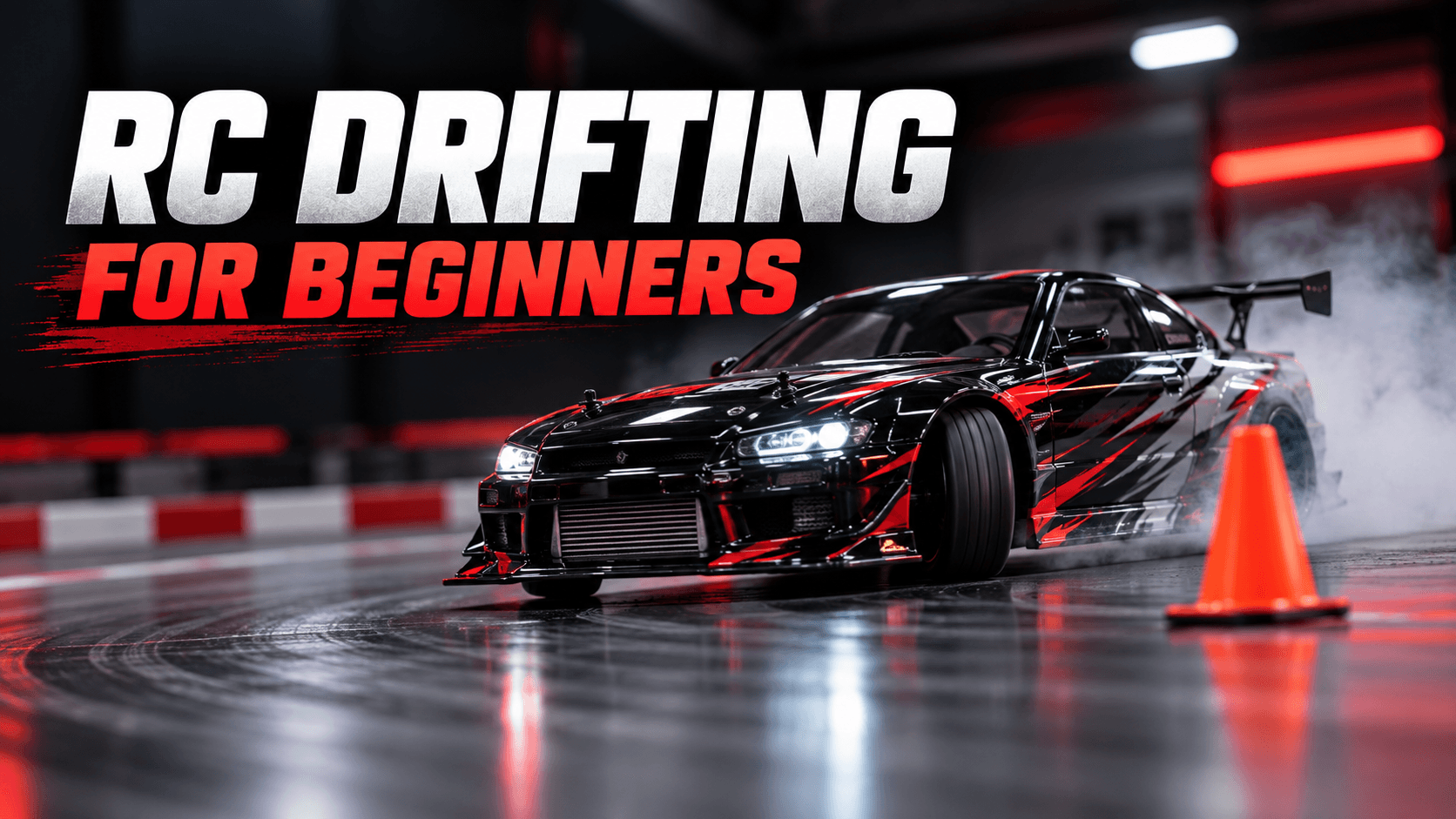
The appeal of a perfect slide
RC drifting looks dramatic, but the fun comes from control. You guide a small car through a corner sideways, then link that corner to the next one without spinning out. A short, clean run around two cones can feel more satisfying than driving at full speed in a straight line.
If you are new to the hobby, you do not need a large track to begin. You need a suitable car, a consistent surface and enough space to practise safely.
Start with the surface
The same car behaves differently on tile, polished concrete, smooth asphalt and carpet. A flat, clean surface makes practice easier because the grip stays predictable. Clear away stones, dust and anything that can catch a wheel. Avoid public spaces where the car could reach people or traffic.
The tyres matter as much as the motor. Dedicated drift tyres are intended to break traction more easily on compatible surfaces. Rubber tyres made for grip can make a car resist sliding, while tyres with too little grip on a slick floor may leave you constantly spinning. Check the tyre and surface pairing recommended for your particular model.
What to look for in your first car
Choose a car with proportional steering and throttle: small movements on the transmitter should produce small movements at the car. Readily available replacement parts are useful, especially steering components, wheels and tyres. A stable chassis with adjustable steering or suspension gives you room to learn as your skills improve.
Four-wheel-drive drift cars can be approachable for casual practice, while dedicated rear-wheel-drive drift platforms reward careful setup and technique. Neither layout automatically guarantees better runs. Your available driving space and the kind of drifting you want to do should guide the choice.
A simple 20-minute practice session
- Five minutes: gentle circles. Place one cone and drive around it in both directions at a steady pace.
- Five minutes: controlled slides. Approach the cone slowly, turn in and add just enough throttle to let the rear step out. Ease off before the car spins.
- Five minutes: figure eights. Put two cones a few metres apart and connect the turns. Focus on a smooth change of direction.
- Five minutes: repeat your cleanest line. Aim for consistency rather than the biggest drift angle.
Small steering corrections and smooth throttle inputs work better than suddenly holding both controls at full travel. If the car spins at every corner, reduce your entry speed first.
Build a course you can change
Use cones, tape markers or lightweight barriers to create a start line, two corners and a finish. Leave enough room for mistakes. Once you can link the corners, narrow the line gradually or add a clipping point. A reusable course makes it easy to see whether your driving is improving.
Keep your car ready for the next run
After driving, brush away dust, inspect the tyres and check that the steering moves freely. Let the electronics cool before packing up. Charge and store the battery according to its manufacturer's instructions. If the car begins pulling to one side, check for debris or damage before changing the transmitter trim.
Find your first RC drift setup at MRC Hobbies
Whether you want a compact drift car for a small practice area or a platform you can tune over time, explore the RC range at mrchobbies.com. Ask us about tyre choice, spares and a setup suited to the surface you plan to use.
MRC Hobbies · 201, P. N. Kothari Industrial Estate, next to Navkar Hospital, Bhandup West, Mumbai, Maharashtra 400078
WhatsApp: +91 7784093093
Instagram: @mrchobbies
YouTube: MRC Hobbies