Why does one wheel spin while the other barely moves?
You place your RC car on uneven ground and press the throttle. One wheel spins quickly, but the car struggles to move forward. Another vehicle crosses the same obstacle with both wheels turning together.
The difference may come from the differential.
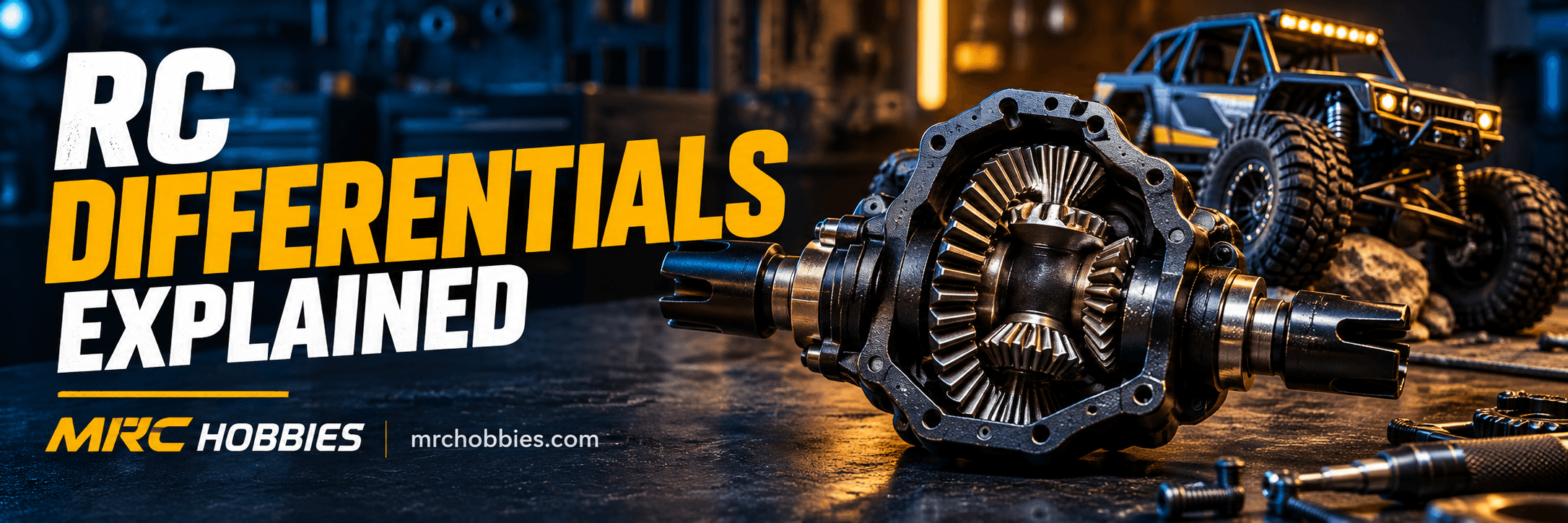
A differential is a drivetrain mechanism that allows its outputs to rotate at different speeds. In an axle differential, those outputs usually drive the left and right wheels. In a centre differential, they connect the front and rear drivetrains.
Understanding this mechanism helps explain why a road car corners smoothly, why a crawler benefits from locked axles, and why changing differential oil can affect handling.
Before replacing parts, understand what your current drivetrain is designed to do.
Why wheels need different speeds in a corner
When a car turns, the outside wheel travels along a longer path than the inside wheel. It needs to rotate faster to cover that distance in the same time.
An axle differential allows this speed difference.
Without it, the wheels must compensate through tire slip, tire deformation, or drivetrain strain. Loose ground allows some slipping quite easily. On a grippy surface, the car may resist turning or scrub its tires through a tight corner.
This explains why a drivetrain arrangement can work well for crawling while feeling less suitable for fast road driving.
What is an open differential?
An open differential allows its outputs to rotate at different speeds with relatively little resistance from the differential mechanism.
This helps the wheels follow their separate paths through a corner. However, traction can become limited when one wheel loses grip.
You may hear that an open differential “sends all the power to the spinning wheel.” More precisely, an ideal open differential delivers approximately equal torque to its outputs. When one tire can support very little torque before spinning, the other side also receives limited torque.
That is why an RC car may become stuck even when one wheel appears to have good contact with the ground.
A spinning wheel does not necessarily mean the other wheel is receiving enough useful driving force.
What is a locked differential?
A locked differential prevents a speed difference between its outputs. Both wheels on that axle rotate together.
This arrangement is common in dedicated crawlers because it helps maintain drive when one wheel becomes lightly loaded or lifts off the ground.
The trade-off appears during cornering. Since the wheels cannot rotate independently, the tires must accommodate their different travel distances through slipping or deformation.
On high-grip surfaces, this can create tire scrub and make tight turns feel less natural.
A locked differential suits a particular purpose. It should not be treated as an automatic upgrade for every RC vehicle.
Open versus locked differentials
FeatureOpen differentialLocked differentialDifferent wheel speedsAllows themPrevents themTight corneringUsually smootherCan create tire scrubOne wheel loses gripUseful drive can become limitedBoth wheels remain coupledCommon applicationRoad cars and general-purpose vehiclesDedicated crawlersMain trade-offReduced traction in uneven-grip situationsGreater resistance to turning on grippy ground
A rally car needs predictable cornering at speed. A crawler needs to keep moving over uneven obstacles. Their drivetrain priorities differ.
What does differential oil do?
Many hobby-grade RC cars use sealed gear differentials filled with silicone differential fluid.
The fluid’s viscosity affects how strongly the differential resists a speed difference between its outputs. Thicker fluid generally increases that resistance; thinner fluid generally allows freer differential action.
The resulting handling change depends on the vehicle, surface, and which differential you adjust.
Thick oil does not create a mechanically locked differential. The outputs can still move at different speeds.
Also, not every differential is designed to hold oil. Some use grease and lack suitable seals. Check your model’s manual before purchasing fluid or opening the assembly.
Front, rear, and centre differentials
A front differential controls the relationship between the front wheels. A rear differential does the same for the rear wheels.
A centre differential allows a speed difference between the front and rear drivetrains.
These positions perform different jobs. Changing front differential fluid is not equivalent to changing centre differential fluid, even when the viscosity is identical.
If another driver shares a setup containing three numbers, confirm:
- Which number refers to the front, centre, and rear.
- Whether your vehicle has the same drivetrain arrangement.
- Which viscosity units and fluid brand were used.
- What driving surface the setup was tested on.
- Which handling problem the driver wanted to solve.
Copying numbers without this context can make your car harder to control.
How to start tuning
Record the factory setup before making changes. Include your tires, battery, driving surface, and existing differential fluids where known.
Next, describe a specific problem.
“The car handles badly” is difficult to diagnose. “The inside front tire spins when accelerating out of a corner” gives you something observable.
Change one differential at a time and make a modest adjustment suitable for your model. Repeat the same route at a similar pace.
Compare corner entry, corner exit, acceleration, and consistency. Keep notes rather than relying only on your first impression.
A setup that feels exciting during one launch may be less useful over a full driving session.
Check mechanical condition first
Differential tuning cannot repair damaged gears, worn bearings, leaking seals, or incorrect assembly.
Before servicing, check for grinding, unusual play, and leakage around the outputs. If a clicking noise appears suddenly, investigate the mechanical cause rather than immediately choosing thicker oil.
During servicing, follow the manufacturer’s filling, shimming, sealing, and tightening procedures. Take photographs during disassembly to help with reassembly.
Cleanliness matters. Dirt entering the differential can shorten component life and affect smooth operation.
Common mistakes to avoid
Avoid treating thicker oil as a universal improvement. Likewise, do not lock a differential simply because another type of vehicle uses locked axles.
Other common mistakes include changing all differentials together, mixing unknown fluids, and comparing results from completely different surfaces.
Preserve your baseline and make changes you can reverse.
Final thoughts
Differentials influence how your RC car corners and maintains traction. Open differentials permit wheel-speed differences, locked differentials keep their outputs together, and suitable oil-filled differentials provide additional tuning options.
Understand the drivetrain first, then adjust it for the terrain and behaviour you want to improve.
Explore RC cars, parts, and accessories: MRC Hobbies
Visit: MRC Hobbies, 201, P. N. Kothari Industrial Estate, next to Navkar Hospital, Bhandup West, Mumbai, Maharashtra 400078
Phone / WhatsApp: +91 77840 93093
Instagram: @mrchobbies
YouTube: MRC Hobbies