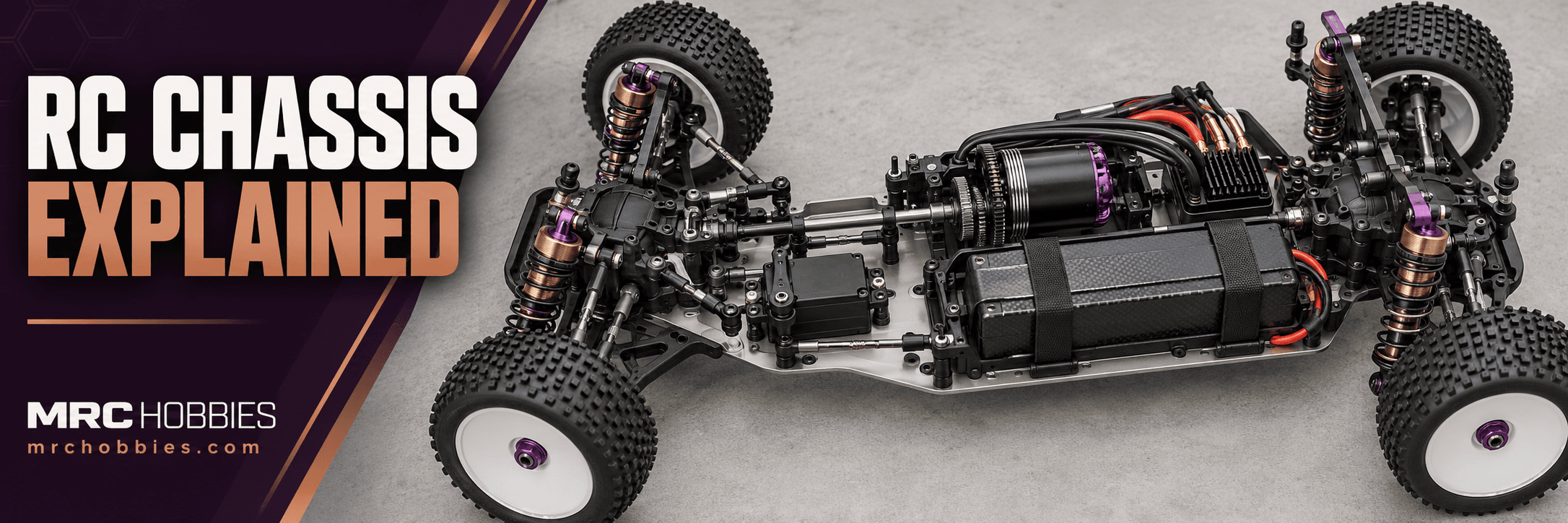
The foundation underneath every RC car
The body shell attracts attention, but underneath it sits the structure that brings the vehicle together: the chassis.
It supports the motor, battery, electronics, and drivetrain. It also provides mounting points for the suspension assemblies or the structures that carry them.
Two RC cars can have similar motors and tires yet behave differently because their chassis layouts differ. Battery position, component height, wheelbase, and structural stiffness all contribute to how the vehicle drives.
Understanding the chassis helps you choose a suitable RC car, diagnose damage, and assess upgrades more carefully.
The most useful question is not simply, “Which chassis material is strongest?” It is: “How does this chassis suit the vehicle’s purpose?”
What is an RC chassis?
The chassis is the vehicle’s main supporting structure.
Depending on the design, it may be a moulded tub, a flat plate, a pair of frame rails, or an assembly combining several structures.
Components commonly attached to it include:
- Battery tray and retaining system.
- Motor mount and transmission.
- Steering servo and steering assembly.
- Electronic speed controller and receiver.
- Suspension mounting structures.
- Body mounts, bumpers, and protective parts.
The body shell and chassis perform different jobs. A shell gives the vehicle its appearance and provides some protection, while the chassis supports the operating components.
Changing the shell usually changes the look. Changing the chassis can affect the layout and behaviour of the whole vehicle.
1. Tub chassis
A tub chassis uses a shaped structure with raised sides and spaces for components.
It is common in many beginner-friendly and general-purpose RC vehicles. Moulded designs can incorporate battery compartments, mounting points, and protective features into the main structure.
The raised sections can help organise and partially shield components, although they do not automatically make the vehicle waterproof or dirt-proof.
For owners, convenient access matters. Check how easily you can remove the battery, reach fasteners, and inspect the drivetrain.
A well-designed tub chassis can be practical, durable, and straightforward to maintain.
2. Plate chassis
A plate chassis uses a relatively flat main structure with components mounted above it.
This layout appears in various racing and off-road vehicles. The plate may be aluminium, carbon fibre, composite, or another suitable material.
Its behaviour depends on thickness, shape, bracing, mounting arrangement, and material properties.
Some designs deliberately allow controlled flex. Others use braces or additional structures to limit movement.
A plate’s clean appearance does not tell you everything about its performance. The complete assembly determines how loads travel through the vehicle.
3. Ladder-frame chassis
A ladder-frame chassis typically uses two longitudinal rails connected by crossmembers.
This arrangement is common in scale crawlers and trail trucks. It resembles the frame layout used by many full-size off-road vehicles.
The rails provide mounting locations for the transmission, suspension links, shock structures, battery tray, and body supports.
For a crawler, the frame works together with axle position, suspension geometry, skid shape, and component placement.
A realistic-looking frame alone does not guarantee climbing ability. The complete vehicle setup matters.
Comparing common chassis designs
Chassis designCommon applicationsFeatures to assessTubGeneral-purpose cars, trucks, and some buggiesComponent access, moulded mounts, protectionPlateRacing cars, buggies, and off-road platformsFlex, bracing, component layoutLadder frameScale crawlers and trail trucksRail layout, link mounts, skid clearanceMulti-part or hybridMany specialist and general-purpose vehiclesHow the structures work together
These categories can overlap. A vehicle may combine a main plate with moulded side structures or use rails alongside separate trays and braces.
Composite, aluminium, or carbon fibre?
Material choice influences weight, stiffness, damage behaviour, and manufacturing options. However, the material name alone does not determine quality.
Moulded plastic and reinforced composites
Moulded chassis structures can integrate complicated shapes and mounting features.
Their properties vary with the material formulation, reinforcement, thickness, and design. Some provide useful flexibility, while others are comparatively rigid.
Inspect damaged examples for cracks, distorted areas, and stripped mounting points.
Aluminium
Aluminium plates are used in many RC platforms. Their behaviour depends on the alloy, thickness, machining, shape, and bracing.
A metal chassis can still bend under a severe impact. It may also transfer loads into attached components.
Check flatness and mounting areas after a hard crash rather than assuming metal means damage-proof.
Carbon fibre
Carbon fibre composites can provide high stiffness relative to weight, making them useful in appropriate designs.
Their performance depends on the laminate and component shape. Impact damage may appear as cracking or separation between layers.
Carbon fibre is also electrically conductive, so electronics and wiring need appropriate installation and protection.
Chassis material comparison
MaterialPotential advantagesImportant considerationsMoulded compositeIntegrated shapes, useful flexibility, practical mounting featuresCracks, material formulation, mounting wearAluminiumSuitable for rigid plates and machined structuresWeight, bending, alloy, thicknessCarbon fibreHigh stiffness relative to weightLaminate quality, impact damage, electrical conductivity
A good design in one material can be more suitable than a poorly matched design in another.
Why centre of gravity matters
The centre of gravity describes where the vehicle’s mass effectively acts.
Placing heavy components lower generally helps reduce the tendency to roll during cornering. Manufacturers use low-centre-of-gravity layouts and conversion kits to improve handling on suitable vehicles. traxxas.com
The battery is particularly important because it represents a substantial part of the vehicle’s mass.
However, low centre of gravity and low ground clearance are different concepts. A design may lower selected components without lowering every part of the chassis equally.
Judge the overall layout rather than the appearance of one mounting tray.
Ground clearance: enough for your terrain
Ground clearance is the space beneath relevant parts of the vehicle.
A smooth road car can operate with relatively little clearance. An off-road vehicle needs enough room to negotiate its intended terrain.
For crawlers, clearance under the central skid is particularly useful when crossing an obstacle between the axles. Axle clearance also depends on axle design and tire size.
Increasing ride height does not automatically improve everything. It can affect suspension geometry and raise parts of the vehicle.
The goal is useful clearance with a balanced setup.
Wheelbase and weight distribution
Wheelbase is the distance between the front and rear axle centres.
It influences the vehicle’s proportions and how it interacts with obstacles. In crawling, for example, an obstacle may fit between the axles of one vehicle but place another on its central skid.
Weight distribution also matters. Moving the battery or other heavy components changes the load carried by each end.
Neither a longer wheelbase nor a more forward battery position is universally better. Evaluate the change for your driving conditions and chassis design.
Should you upgrade the chassis?
A chassis conversion is most useful when it addresses a specific need.
Possible reasons include replacing damaged structure, changing component placement, or using a manufacturer-supported conversion for a different driving purpose.
Before purchasing, confirm:
- Exact model and chassis version.
- Compatible drivetrain and suspension mounts.
- Required braces, trays, hardware, and supporting parts.
- Battery fit and body mounting compatibility.
- Any changes to clearance or service access.
Do not choose a conversion solely because it is aluminium or carbon fibre.
For many owners, maintaining the existing chassis and improving tires or setup is a more practical first step.
Inspecting and maintaining your chassis
After driving, remove dirt and inspect accessible mounting areas.
Following a hard impact, look for cracks, bent plates, loose braces, damaged threads, and displaced components. Check that battery restraints and electronics remain secure.
If handling changes suddenly, inspect for structural damage before adjusting suspension settings.
Use the correct replacement hardware and tightening procedure. Longer screws can interfere with nearby components, while excessive tightening can damage threads.
Common mistakes to avoid
Avoid assuming that maximum stiffness always improves performance. Chassis flex can be part of a deliberate vehicle design.
Other mistakes include adding heavy decorative parts high above the chassis, ignoring damaged mounting points, and buying conversions without checking all supporting components.
Keep a record of the original layout before making changes.
Final thoughts
The chassis provides the foundation for your RC vehicle’s layout, handling, and serviceability.
Choose and assess it as a complete design: structure, material, component placement, clearance, and compatibility. Understanding these details helps you make upgrades that serve a clear purpose.
Explore RC cars, parts, and accessories: MRC Hobbies
Need help checking chassis compatibility? Share your exact RC model and the part you are considering on WhatsApp.
Visit: MRC Hobbies, 201, P. N. Kothari Industrial Estate, next to Navkar Hospital, Bhandup West, Mumbai, Maharashtra 400078
Phone / WhatsApp: +91 77840 93093
Instagram: @mrchobbies