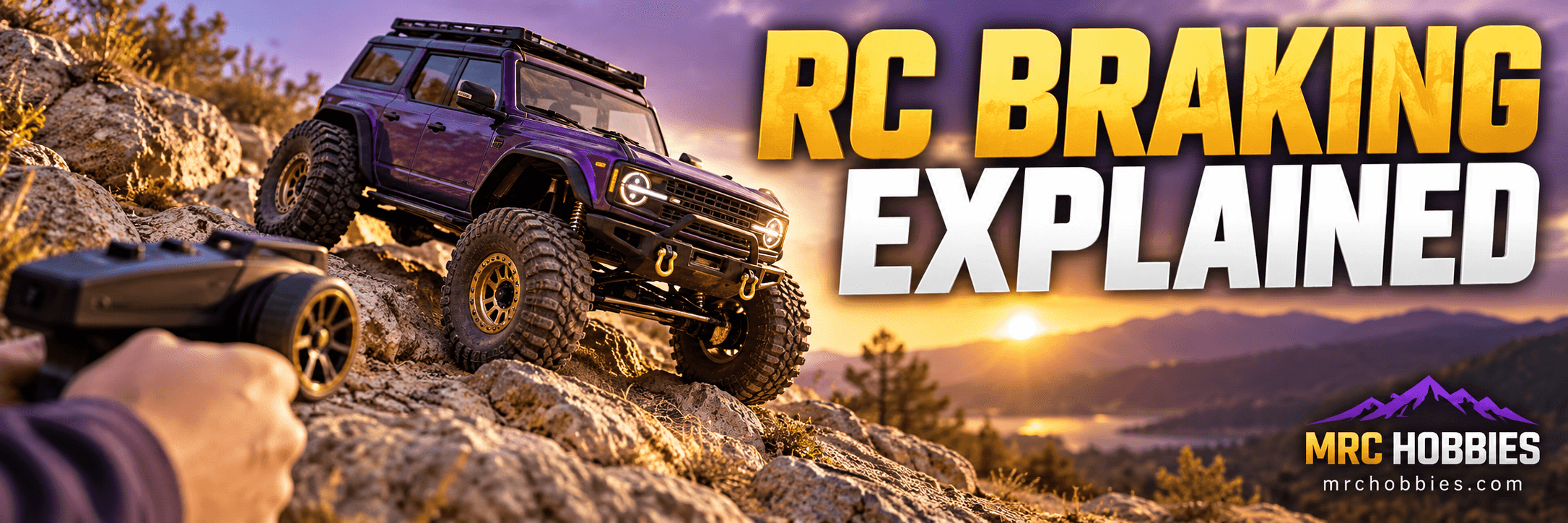
Control also means slowing down predictably
Acceleration gets plenty of attention, but braking determines how confidently you approach corners, obstacles, and descents.
An RC car that brakes too abruptly can become unsettled. One that slows too weakly can be difficult to place accurately.
Electric RC braking commonly works through the motor and ESC, although vehicle designs vary.
Understanding the available settings helps you make adjustments without confusing braking with reverse or neutral behaviour.
Commanded braking
On many surface transmitters, moving the trigger away from the acceleration direction commands braking.
The ESC interprets that input according to its operating mode and calibration.
Maximum brake strength is a limit or setting for the braking command. Depending on the controller, partial trigger movement may provide proportional braking.
The setting does not guarantee the same stopping distance on every surface. Tire grip and vehicle condition still matter.
What is drag brake?
Drag brake is braking applied when the throttle returns to neutral.
It can reduce free coasting and is useful in some crawler setups. Its behaviour depends on the controller and motor system.
Hobbywing defines drag brake in crawler documentation as motor braking when the trigger returns to neutral. hobbywing.com
A drag brake is not a guarantee that the car will remain stationary on every incline.
Commanded brake versus drag brake
FeatureCommanded brakeDrag brakeActivationDriver applies brake inputTrigger returns to neutralTypical purposeDeliberately slow the vehicleControl neutral coastingUseful adjustmentMaximum strength and responseNeutral braking force and responseMain considerationGrip and vehicle stabilityDesired coasting or crawling behaviour
A fast car and a crawler may therefore need different neutral behaviour.
Why reverse modes matter
Some controllers require a brake action before reverse becomes available. Others offer a crawler mode with a different sequence.
Read the operating-mode description before changing settings.
An unexpected reverse response may result from selecting an unsuitable mode, incorrect calibration, or unfamiliarity with the sequence.
Do not repeatedly push the trigger while diagnosing the behaviour in a confined area.
Grip limits braking
More brake command does not always produce a shorter, more controllable stop.
If the tires lose grip, the car can slide. Surface dust, wet patches, tire wear, and vehicle weight transfer all affect the result.
Test braking on the same surface where you normally drive. Begin at low speed with ample clear space.
Increase the setting gradually rather than starting with the maximum available value.
Crawler braking and descents
For crawling, evaluate how smoothly the vehicle transitions from drive to neutral and how it responds on a modest slope.
An abrupt response can disturb the vehicle’s balance. A weak response may require more active trigger control.
Choose a safe, low-consequence test area. Avoid using a steep edge as the first test.
The vehicle’s gearing, tires, weight distribution, and motor system influence the outcome alongside the ESC setting.
Check calibration and mechanics
Before tuning, confirm that the ESC recognises neutral and the correct brake endpoint.
Check transmitter trim and brake-related limits according to the calibration instructions.
Also inspect the drivetrain. A car that rolls reluctantly because of binding should not be treated as having effective drag brake.
Mechanical resistance and electronically commanded braking are different conditions.
Monitor operating conditions
Braking settings can affect system demands. Hobbywing documentation notes that drag brake can increase power consumption and heat in applicable systems. hobbywing.com
Follow the manual’s limits and compare short tests before committing to a setting.
Record both the setting and the driving conditions.
Common mistakes to avoid
Avoid treating drag brake as a parking brake, selecting maximum strength without testing, or confusing reverse delay with a fault.
Do not change calibration, operating mode, and brake strength simultaneously.
Final thoughts
Good braking is predictable and appropriate for the vehicle and terrain.
Understand commanded braking, drag brake, and reverse behaviour separately, then tune through controlled tests.
Shop: MRC Hobbies
Visit: MRC Hobbies, 201, P. N. Kothari Industrial Estate, next to Navkar Hospital, Bhandup West, Mumbai, Maharashtra 400078
Phone / WhatsApp: +91 77840 93093
Instagram: @mrchobbies