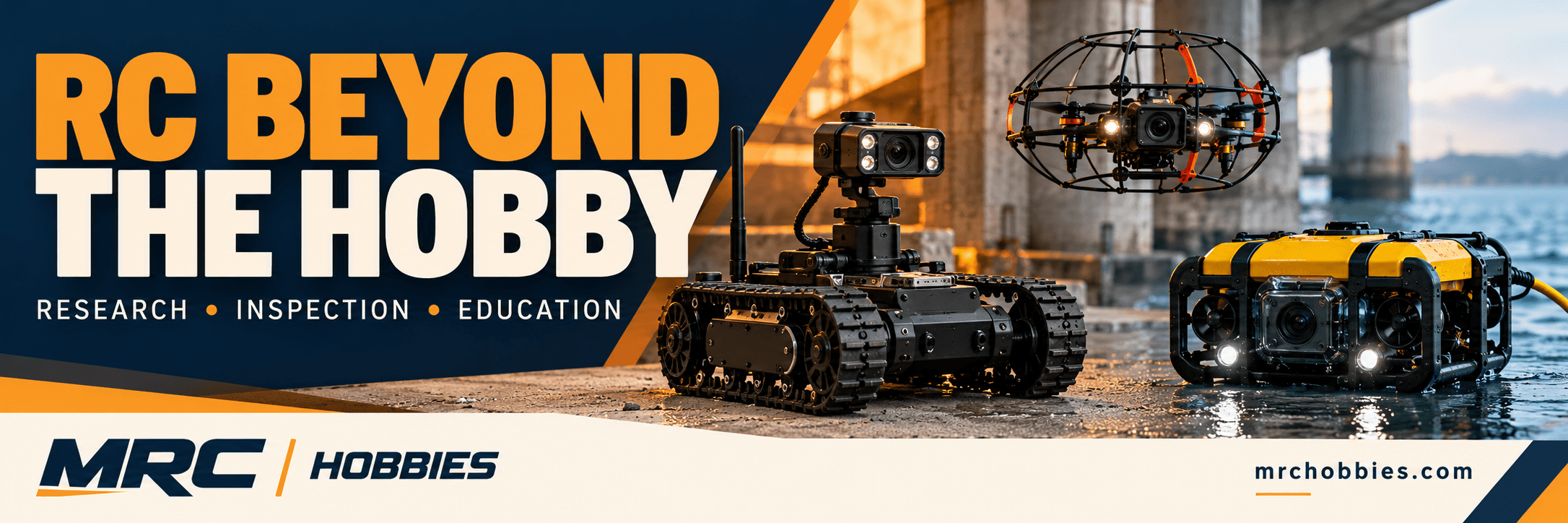
An RC vehicle demonstrates a powerful idea: a person can operate a machine without being physically inside it.
Beyond hobbies, remote-operation systems help people observe places, perform specialised tasks and learn engineering concepts.
Radio control, remote operation and autonomy are related but different. Remote-operated machines may use cables or networks, while autonomous systems make some decisions onboard.
1. Industrial Inspection
Specialised inspection drones carry cameras and other equipment into locations that are difficult to inspect directly.
Flyability documents power-plant applications, including inspections inside confined spaces and environments where GPS is unavailable. flyability.com
Professional inspection requires equipment designed for the task. Sensors, communications and environmental suitability matter alongside the ability to move remotely.
2. Emergency Response
Response robots can support teams working in difficult or hazardous environments. NIST’s response-robot programme evaluates both robotic capabilities and the proficiency of remote operators and pilots. NIST
This shows why the operator matters as much as the machine. People must interpret the information received and control the equipment effectively.
These applications use purpose-built systems rather than assuming hobby vehicles are suitable for emergency work.
3. Underwater Exploration
Remotely operated vehicles, or ROVs, let operators at the surface explore underwater environments.
NOAA describes ROVs connected to a ship by cables that transmit command and control signals. oceanservice.noaa.gov
This is an important distinction: a remotely operated underwater machine is not necessarily radio-controlled.
NOAA also distinguishes ROVs from autonomous underwater vehicles, which use a different operating approach. NOAA Ocean Exploration
4. Engineering Education
Small vehicle platforms can help students connect engineering concepts to visible movement.
A teaching project might begin with manual driving, then introduce measurements, sensors and programming. Possible learning tasks include:
- Following a marked route.
- Comparing steering settings.
- Recording sensor measurements.
- Documenting how a design change affects behaviour.
Choose a clear task suited to the learners and equipment.
5. Autonomous-Vehicle Research
F1TENTH course materials describe a 1:10-scale platform for autonomous-systems research and education, covering topics such as perception, planning and control. Getting Started
This extends a small vehicle platform beyond manual driving. Researchers can investigate how a system interprets its surroundings and selects actions.
An ordinary RC car does not become self-driving simply because it has a receiver or stability assistance.
Comparing the Applications
FieldTypical purposeImportant distinctionIndustrial inspectionCollect visual or sensor informationEquipment must suit the environmentEmergency responseAssess difficult or hazardous areasOperator proficiency mattersUnderwater explorationObserve underwater environmentsMany ROVs use a tetherEducationLearn vehicle and control conceptsTasks should match learner experienceAutonomous researchStudy perception, planning and controlOnboard decisions differ from manual RC
What Hobby RC Can Teach
Hobby vehicles provide an introduction to component identification, maintenance, controlled testing and the relationship between a command and a vehicle’s response.
These are useful foundations for further learning. Professional applications add requirements such as specialised sensing, communications, payload capability and validated performance.
Final Thoughts
Remote-operation technology connects hobbies with wider engineering ideas—from underwater exploration to autonomous-driving research.
Start with a clear task, understand the system and build knowledge through observation and testing.
Contact MRC Hobbies to discuss RC vehicles and educational project interests.
Visit MRC Hobbies
Address: 201, P. N. Kothari Industrial Estate, next to Navkar Hospital, Bhandup West, Mumbai, Maharashtra 400078.
Phone / WhatsApp: +91 77840 93093
Website: mrchobbies.com
Instagram: @mrchobbies
YouTube: MRC Hobbies