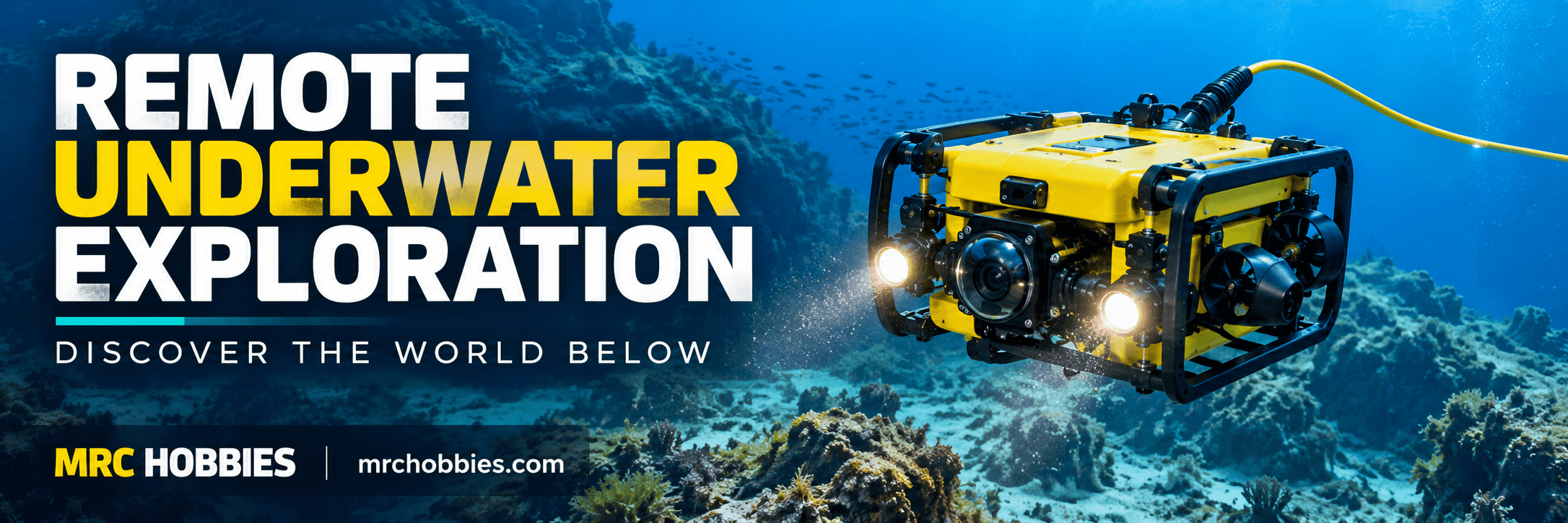
Remote operation extends beneath the surface through machines called remotely operated vehicles, or ROVs.
Like an RC vehicle, an ROV responds to commands from a person located elsewhere. Its underwater environment introduces a different set of engineering questions: how will it move, remain balanced, keep water away from sensitive components and send information to its operator?
The shared principle is remote control. The communication method can differ considerably from hobby RC, because many underwater ROVs use a tether.
For enthusiasts interested in engineering, this makes underwater robotics a fascinating extension of familiar control concepts.
What Is an ROV?
NOAA describes an ROV as an unoccupied underwater vehicle operated from the surface, with cables connecting it to its operators. These connections support command and control. oceanservice.noaa.gov
Depending on its design, the vehicle can carry cameras, lights, instruments or tools.
The complete system includes more than the underwater machine. The surface controls, connection and operating team all contribute to its performance.
Why Water Changes the Design
A land vehicle is supported by the ground. An underwater vehicle moves within the water, where buoyancy and weight influence whether it tends to rise, sink or hold depth.
The placement of components affects balance, while the propulsion arrangement influences the movements the vehicle can make.
Water also introduces enclosure and connection challenges. Components need to be selected and assembled for the conditions in which they will operate.
A supervised shallow-water educational project therefore has a different scope from a vehicle intended for deeper research.
Understanding the Tether
The tether is an important part of many ROV systems.
It connects the underwater vehicle to the surface, allowing the operator to send commands and receive information through the system’s specified arrangement.
This highlights a useful distinction: remote control describes the relationship between an operator and a machine, while radio describes one possible communication method.
A tethered machine can be remotely operated without using the same wireless setup as a hobby RC car.
How Operators Observe Underwater
The operator guides the vehicle using the information returned by its instruments.
In ocean exploration, pilots may review live video and sonar information while directing their work. oceanexplorer.noaa.gov
The viewing position matters. A wide view may help show the surroundings, while examining a smaller feature may require a different angle or distance.
Vehicle movement supports the observation. The objective is to place the instruments where they can collect useful information.
Seeing Clearly Is an Engineering Challenge
A camera’s resolution is only one influence on the returned image.
Available light, suspended material, camera position and vehicle movement can affect what the operator sees. Lighting and viewpoint therefore need to be considered together.
The research question determines what constitutes a useful view. Recording an overview of a habitat and examining a small feature may require different positions or instruments.
This is similar to RC photography: a capable camera still needs a suitable viewpoint and conditions.
Where Are ROVs Used?
ROVs support observation of underwater habitats and exploration of ocean environments. They allow researchers to view and document submerged surroundings. oceanexplorer.noaa.gov
A recording becomes more useful when connected to context, such as its location, the purpose of the observation and the conditions under which it was made.
Keeping track of what was visible—and what remained unclear—helps other people understand the information collected.
ROV vs AUV: Understanding the Difference
AspectROVAUVFull nameRemotely operated vehicleAutonomous underwater vehicleControlDirected remotely by a personOperates autonomouslyConnectionCommonly tethered to the surfaceOperates without continuous tethered controlCore principleOperator commands and feedbackOnboard mission execution
NOAA distinguishes these vehicle types. Understanding the difference helps readers compare underwater technologies without assuming every vehicle is driven in the same way. oceanservice.noaa.gov
A Learning Path for RC Enthusiasts
Start with the principles of control and feedback using a dry-land educational project.
Then explore buoyancy, sealing, underwater propulsion and the communication arrangement of an educational underwater platform.
A supervised test should have a defined objective. It might examine stable movement, readable camera footage or accurate positioning.
Record what the test demonstrates and the conditions under which it succeeds. A successful test answers that particular question; it does not establish performance in every environment.
Practical Checklist
- Define the observation or learning objective.
- Understand the control and communication system.
- Check equipment suitability for the intended conditions.
- Consider buoyancy and balance.
- Evaluate camera visibility and lighting.
- Record observations with their context.
- Distinguish remote control from autonomous operation.
Common Mistakes to Avoid
Not every remotely operated vehicle uses radio communication. ROV and AUV also describe different forms of operation.
Water resistance should not be treated as proof of suitability for prolonged underwater use. Likewise, a camera alone does not establish the usefulness of the complete system.
Underwater performance depends on the vehicle, its instruments, its connection and the operating environment working together.
Final Thoughts
Underwater ROVs connect remote control with exploration and scientific observation. They give RC enthusiasts a route into learning about marine engineering, sensing, buoyancy and feedback.
Explore RC and Robotics with MRC Hobbies
Explore remote-control technology and educational projects at MRC Hobbies.
Address: 201, P. N. Kothari Industrial Estate, next to Navkar Hospital, Bhandup West, Mumbai, Maharashtra 400078.
Phone / WhatsApp: +91 77840 93093
Instagram: @mrchobbies
YouTube: MRC Hobbies