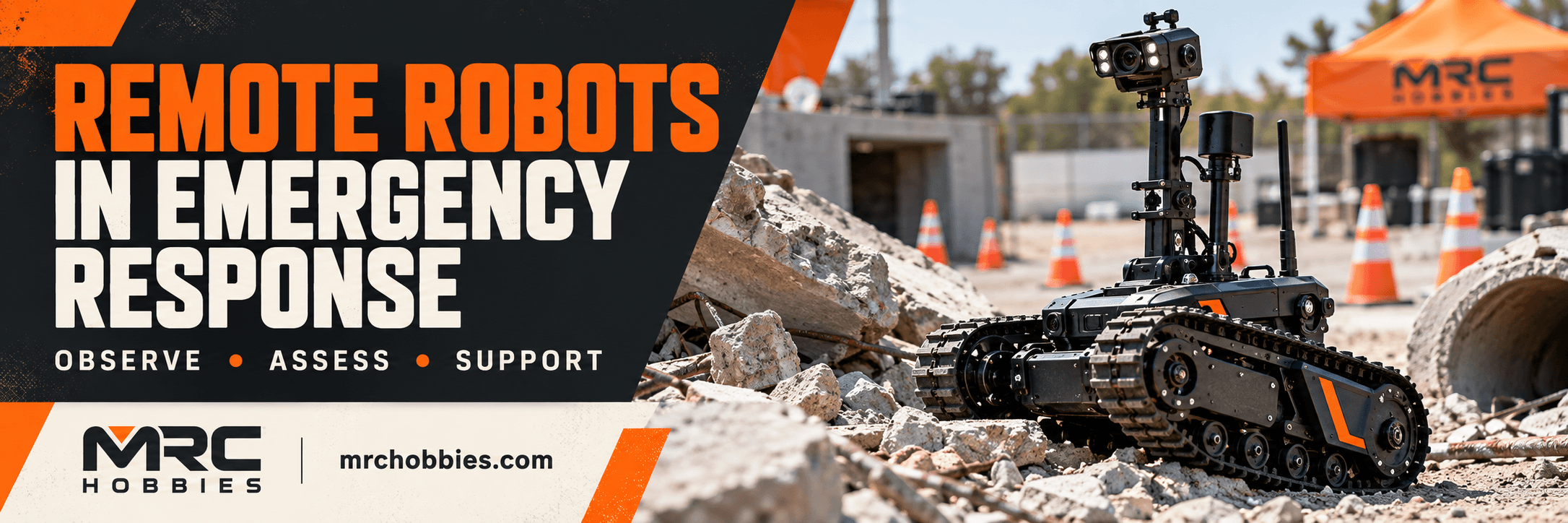
RC hobbies introduce people to the relationship between an operator, a control system and a moving machine. Emergency-response robotics uses related principles for tasks with a different purpose.
A remotely operated robot can carry cameras or sensors into an area while its operator remains elsewhere. The information returned can help a wider team understand the surroundings and assess what it has observed.
The robot’s contribution depends on the task, the capability of the equipment and the skill of the people operating it.
For RC enthusiasts, this field demonstrates why control accuracy and useful feedback can matter as much as the machine’s physical performance.
What Does a Response Robot Contribute?
A remote platform gives a team a way to position instruments and obtain a view from another location.
Its operator directs movement while reviewing the returned information. Other team members can use those observations as part of their assessment.
NIST’s response-robot programme evaluates robotic capabilities and the proficiency of remote operators and pilots working in challenging environments. Its work treats equipment performance and operator proficiency as connected requirements. www.nist.gov
The machine supports the team’s work, while people determine how its observations fit into the response plan.
Why Camera-Based Control Is Different
Someone standing beside a vehicle can look around, change position and judge distances from several angles.
A remote operator depends on the views and information the system provides. A forward-facing camera may show the route ahead while revealing less about the sides or rear.
This changes how movement is judged. Accurate positioning may require small corrections, and the operator needs to recognise when the available view is insufficient.
RC enthusiasts who have tried camera-based driving can appreciate the challenge: familiar controls can feel different when the viewpoint changes.
Wheels, Tracks and Terrain
Mobility should be evaluated against the intended task.
Wheel size, ground clearance, the platform’s shape and its turning behaviour influence how it negotiates obstacles. Tracks are one design option, but their presence alone does not establish the capability of the complete system.
A machine that performs well on one course may struggle on another. For that reason, descriptions such as “rugged” or “off-road” are less informative than performance on a defined task.
This is another familiar lesson from RC. Different layouts and terrain reveal different strengths and limitations.
What Makes the Complete System Useful?
AreaEvaluation questionMobilityCan the platform negotiate the required terrain?ObservationCan the operator see the details needed?ControlCan the machine be positioned accurately?CommunicationDoes the connection support the task?Operator proficiencyCan the operator perform consistently?ReportingCan observations be communicated clearly?
From Camera Images to Team Communication
Obtaining a view is only one part of the task. The operator also needs to explain what it shows.
A useful report identifies what is visible, where it is located and which areas remain outside the view. This helps another person understand the limits of the observation.
Separating observations from assumptions improves clarity. For example, reporting that a marked object is visible beside a barrier is more precise than drawing conclusions about an area that has not been examined.
This discipline is valuable in educational robotics as well as professional work.
Why Repeatable Testing Matters
A demonstration shows performance under the conditions of that demonstration.
More meaningful evaluation uses defined tasks, repeatable conditions and records of both successful and unsuccessful attempts. NIST develops quantitative methods for evaluating emergency-response robot performance and examining design tradeoffs. www.nist.gov
Operator familiarity also affects results. Comparing two machines with very different levels of operator practice can mix equipment capability with training differences.
Keeping these factors visible makes the comparison easier to interpret.
A Classroom Activity That Connects the Ideas
Create a supervised course with harmless obstacles and numbered markers.
Let an operator guide a camera-equipped vehicle while a second student records observations. A supervisor should be able to see the entire course.
Afterward, compare the report with the actual layout. Which markers were identified correctly? Which were missed? Were their locations described clearly?
Repeating the same exercise can reveal whether performance is consistent. It also shows how vehicle control, observation and communication work together.
Practical Checklist
- Define the task before comparing machines.
- Examine camera coverage and visibility.
- Evaluate mobility on relevant obstacles.
- Understand the communication requirements.
- Include operator proficiency in the assessment.
- Record uncertainty and incomplete observations.
Common Mistakes to Avoid
Rugged styling does not prove suitability for emergency-response work. Automation also does not remove the need for training.
Another mistake is treating the quickest completion as the best result. Depending on the task, accurate observations and clear reporting may be more useful than speed.
Classroom exercises introduce these ideas, while actual deployment requires the appropriate professional equipment, evaluation and training.
Final Thoughts
Emergency-response robotics connects remote operation with purposeful observation. The useful result comes from a complete system: suitable equipment, skilled operators and clear communication within the team.
Explore RC and Robotics with MRC Hobbies
Discover RC vehicles, control systems and educational electronics at MRC Hobbies.
Address: 201, P. N. Kothari Industrial Estate, next to Navkar Hospital, Bhandup West, Mumbai, Maharashtra 400078.
Phone / WhatsApp: +91 77840 93093
Instagram: @mrchobbies
YouTube: MRC Hobbies