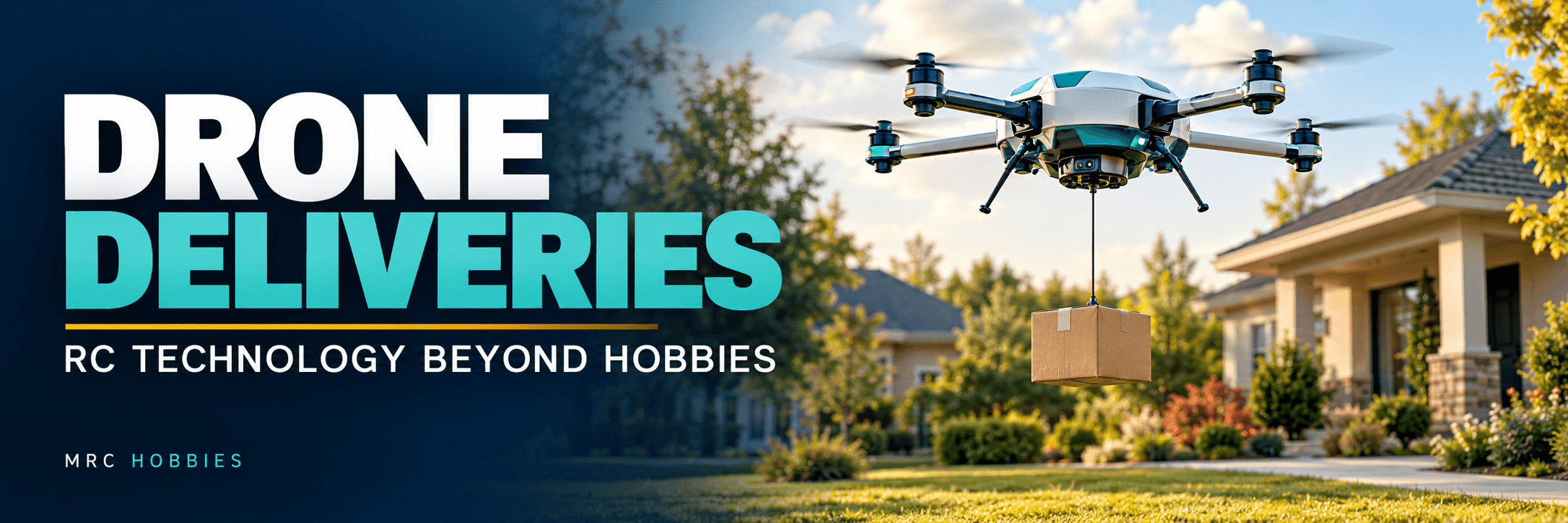
Imagine ordering a small household item and receiving it from an aircraft that lowers the package into a designated delivery area. Now consider a health facility receiving medical supplies through an aerial distribution network.
Both examples show how technology familiar to RC enthusiasts can become part of a practical logistics service.
The connection begins with electric propulsion, batteries, flight control and communication. Delivery systems combine these elements with navigation, package handling, mission management and professional operations.
Many commercial delivery aircraft fly autonomously under operational supervision. Their connection to RC lies in the underlying control technologies, rather than every flight being continuously steered through a handheld transmitter.
What Is Drone Delivery?
Drone delivery uses an unmanned aircraft to transport a payload between locations. That payload might be a retail item, a prepared meal or medical supplies.
The aircraft is only one part of the service. An order must be checked, the package prepared, the destination identified and the handover completed.
Different systems solve the delivery problem differently. Some lower a package on a tether, while others use a parachute delivery method. The aircraft design and receiving arrangements depend on the purpose of the service. wing.com
United States: Everyday Essentials Delivered by Wing
The United States provides a current example of drones being integrated into retail delivery.
In July 2026, Wing and Walmart announced the start of drone delivery in Greater Orlando, Florida. Eligible customers could order selected everyday essentials, with availability depending on their address and the service area.
Wing describes lowering packages to the ground using a tether. The aircraft therefore does not need to land beside the customer to complete the delivery. wing.com
This example illustrates how drone delivery can fit into an existing shopping experience. Customers select eligible goods, the retailer prepares the order, and the aircraft handles the aerial transport.
The engineering challenge includes the complete journey—from order preparation to a clear and dependable handover.
Rwanda: Drones Supporting Medical Logistics
Rwanda demonstrates a different application: transporting medical supplies.
Zipline’s partnership with Rwanda began in 2016. Its network has supported on-demand access to blood, vaccines and essential medicines.
In a 2026 announcement, Zipline described further expansion, including urban delivery using its Platform 2 technology and an additional long-range distribution centre. These announced developments should be distinguished from services already operating at every planned location. Zipline
The important lesson is the purpose of the mission. In healthcare logistics, the objective is to get the required supplies to the receiving facility when they are needed.
The drone is part of that wider supply chain, alongside storage, ordering, packaging and the healthcare team receiving the shipment.
Ghana: A Documented Medical-Delivery Programme
Ghana partnered with Zipline in 2019 to deliver medical supplies, including vaccines, from distribution centres to health facilities.
Zipline’s published account describes routine vaccine deliveries and the programme’s role during the COVID-19 response. It also explains the importance of validated storage and packaging for temperature-sensitive products. Zipline
This shows why transporting a medical product involves more than lifting a box.
The handling process must suit the contents throughout the journey. Preparation, storage and receiving procedures are therefore part of the delivery system.
Ghana is a documented example of this technology’s use. Historical programme descriptions should not be treated as proof that every facility, contract or service level remains unchanged today.
Ireland: Retail Delivery and a Lesson About Scaling
Manna developed delivery services in Irish communities, transporting groceries, meals, pharmacy products and other everyday goods.
However, on 19 June 2026, the company announced that it would pause its Irish delivery operations and review their future. Manna attributed the decision to uncertainty around the national policy framework and local planning requirements. Manna
Ireland therefore provides an important example of both technical achievement and the challenges of operating a service.
A functioning aircraft does not guarantee that a delivery network can continue or expand. Ground infrastructure, planning and the commercial operating environment also influence the outcome.
Comparing the Country Examples
CountryExampleMain applicationStatus described hereUnited StatesWing and WalmartEveryday retail goodsFlorida service launched in July 2026RwandaZiplineMedical logisticsEstablished network with expansion announcedGhanaZiplineMedical supplies and vaccinesDocumented programme launched in 2019IrelandMannaMeals and everyday goodsIrish service pause announced in June 2026
These examples show that drone delivery serves different needs. A household order and a medical resupply may both travel by air, but their handling requirements and receiving arrangements differ. wing.com
How a Delivery Mission Fits Together
A broad delivery workflow begins by checking whether the item, destination and operating conditions are eligible.
The package is then prepared for the aircraft’s specified delivery system. After dispatch, the aircraft performs its mission according to the operator’s procedures.
At the destination, the package is transferred using the system’s delivery method. The aircraft then continues its mission, which may include returning or repositioning.
This is a general description rather than one universal process. Each operator has its own equipment and procedures.
The useful insight is that successful flight and successful delivery are related but separate achievements. The recipient must receive the correct item through a dependable process.
Hobby Drones and Commercial Delivery Systems
AspectHobby droneCommercial delivery systemMain purposeFlying, photography, learning or racingTransporting an eligible payloadControlOften direct pilot control with assistanceMay use autonomous missions with supervisionPayloadDepends on the model’s intended useDefined package and handling requirementsGround preparationPreparing for an individual flightPreparing orders, dispatch and receiving arrangementsSuccess measureMeeting the pilot’s flying objectiveCompleting a dependable delivery
For RC enthusiasts, the familiar components are a starting point. The wider logistics process adds another layer of engineering.
Why Package Weight Is Only One Consideration
Payload weight matters, but it does not describe the entire task.
Package size, attachment, balance and protection also influence the system. The way the recipient receives the item must be considered too.
For medical products, handling requirements can be especially important. For household goods, the receiving location and transfer method shape the customer experience.
A useful comparison therefore asks three questions: what can the system transport, under which conditions, and how does the recipient receive it?
Benefits and Practical Limits
Drone delivery offers another transport option for suitable shipments.
Its usefulness depends on the task. A small urgent item, a medical resupply and a large weekly shopping order present different requirements.
Aircraft limits, weather, service boundaries and receiving arrangements influence availability. The presence of a delivery service in a country does not mean every address or product is eligible.
The examples suggest that the strongest approach is to match aerial delivery to a specific need, then build the supporting process around it.
What RC Enthusiasts Can Learn
Delivery drones bring together propulsion, power, control, sensing and communication. They also introduce questions about payload handling and mission completion.
A supervised educational activity can explore these ideas using a ground vehicle carrying a harmless object between marked stations.
Students can record whether the vehicle reaches the correct destination, whether the item remains secure and whether the handover is clear.
This combines RC operation with an introduction to logistics and demonstrates that completing the task involves more than moving quickly.
Common Mistakes to Avoid
- Assuming every delivery drone is continuously flown with a hobby transmitter.
- Presenting an announced expansion as an operating nationwide service.
- Comparing systems only by speed or payload weight.
- Ignoring packaging and receiving arrangements.
- Using older country examples as proof of current availability.
Final Thoughts
Delivery drones show how technologies familiar to RC enthusiasts can develop into a complete transport service.
The examples abroad range from household essentials to medical supplies, with different aircraft and delivery arrangements. Their shared objective is practical: getting the correct item to the correct recipient through a dependable process.
Explore RC and Robotics with MRC Hobbies
Explore RC technology, electronics and educational projects at MRC Hobbies.
Address: 201, P. N. Kothari Industrial Estate, next to Navkar Hospital, Bhandup West, Mumbai, Maharashtra 400078.
Phone / WhatsApp: +91 77840 93093
Instagram: @mrchobbies
YouTube: MRC Hobbies