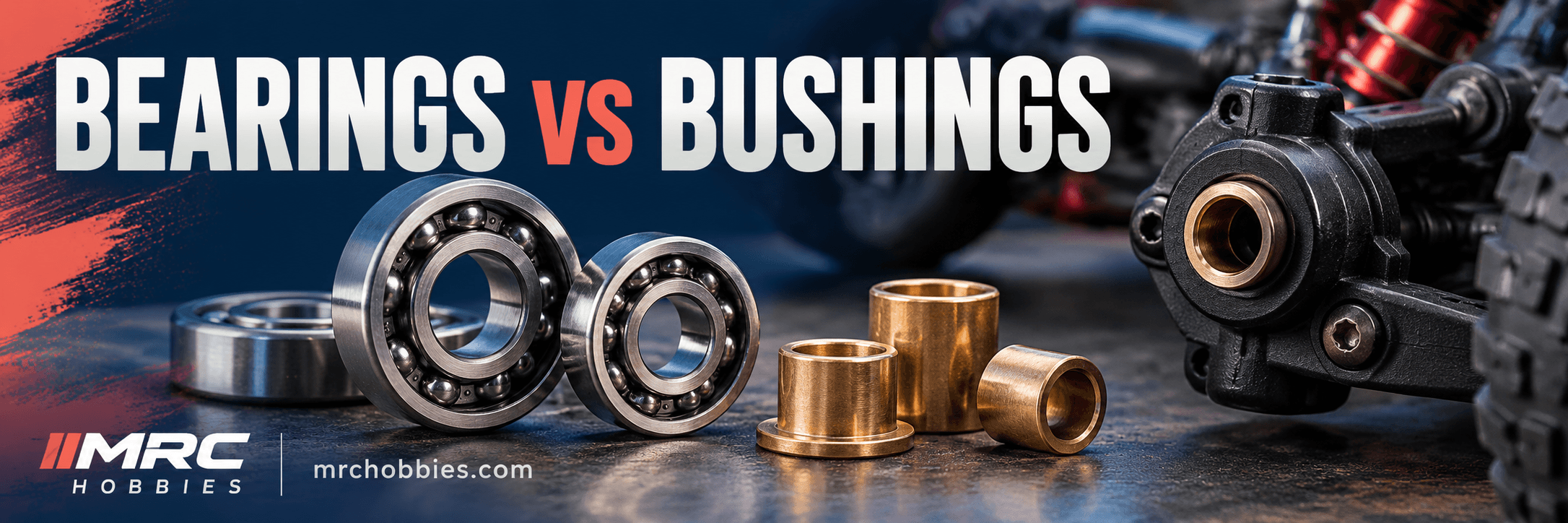
Small components with an important job
Inside an RC wheel hub, gearbox, or steering assembly, small components support moving shafts and parts.
These supports may be ball bearings or bushings. They are easy to overlook because they are less visible than motors, tires, and shocks.
However, a worn or damaged support can create play, noise, or resistance. That can affect the surrounding components and make the vehicle less pleasant to drive.
Understanding the difference helps you diagnose problems and select the correct replacement.
What is a bushing?
A bushing is a plain bearing: a sleeve or supporting surface against which another component moves.
Bushings can be made from different materials, including suitable plastics or metals. Their design, clearance, material, and lubrication determine how they perform.
They are mechanically simple and can suit certain low-speed or lightly loaded applications.
A bushing is not necessarily a poor component. It may be the intended solution for a particular mechanism.
What is a ball bearing?
A ball bearing uses rolling elements between an inner and outer race.
The rolling elements allow relative movement while supporting the shaft. Ball bearings are widely used in RC wheel hubs, drivetrain assemblies, and other rotating parts.
Their behaviour depends on quality, size, internal clearance, lubrication, sealing, and installation.
A bearing that is dirty, corroded, or damaged may create more trouble than a healthy bushing.
Comparing the two
FeatureBushingBall bearingOperating principleSliding contactRolling contactConstructionRelatively simpleRaces, balls, and retaining structureTypical wearSupporting surface wearsRaces, balls, seals, or cage can deteriorateMaintenanceDepends on material and applicationDepends on sealing and lubricationReplacement requirementCorrect dimensions and materialCorrect dimensions and specification
The complete application determines which is suitable.
Does a bearing conversion always improve the car?
Replacing suitable bushings with compatible bearings can reduce resistance in some assemblies. However, the outcome depends on the original design and condition.
It will not repair a bent shaft, damaged housing, or incorrectly tightened assembly.
A conversion should use a manufacturer-listed kit or clearly verified dimensions. Do not force a bearing into a housing that was not designed to accept it.
Also check whether washers, spacers, or other parts must change.
How to identify a bearing size
Bearing dimensions are commonly expressed as:
Inner diameter × outer diameter × width
All three matter. Two bearings can share the same inner diameter while having different widths or outer diameters.
Use the parts list or exploded diagram to identify the correct bearing. Measuring a worn part can help, but it should not replace reliable model-specific information.
Some parts lists distinguish between bearings and bushings used in different assemblies on the same vehicle. traxxas.com
Signs that something needs attention
Possible warning signs include:
- Roughness when an isolated bearing turns.
- Unusual noise.
- Excessive shaft movement.
- Visible corrosion.
- A wheel that moves reluctantly.
- Repeated wear in nearby components.
These signs require investigation. A wheel’s resistance could come from a bearing, drivetrain, brake mechanism, or incorrect assembly.
Isolate the affected part according to the service instructions.
Cleaning and replacement
Follow the manufacturer’s maintenance procedure for the actual bearing type.
Do not assume every sealed bearing should be opened, washed, and re-oiled. Some are intended to be replaced when their condition deteriorates.
Manufacturer maintenance guidance recommends checking bearings for corrosion and smooth movement and replacing unsuitable ones. traxxas.com
During installation, avoid forcing components together or applying loads through the wrong part of the bearing. Refit spacers and washers in their correct positions.
Common mistakes to avoid
Avoid ordering by appearance, mixing dimensions, or overtightening an assembly until it binds.
Also avoid spraying exposed mechanisms indiscriminately with lubricant. The wrong product or application can attract contamination or affect nearby materials.
Final thoughts
Bearings and bushings both support movement, but they do so differently.
Select replacements by specification, diagnose the actual fault, and maintain them according to the model’s instructions. Smooth movement depends on the whole assembly.
Shop: MRC Hobbies
Visit: MRC Hobbies, 201, P. N. Kothari Industrial Estate, next to Navkar Hospital, Bhandup West, Mumbai, Maharashtra 400078
Phone / WhatsApp: +91 77840 93093
Instagram: @mrchobbies
YouTube: MRC Hobbies