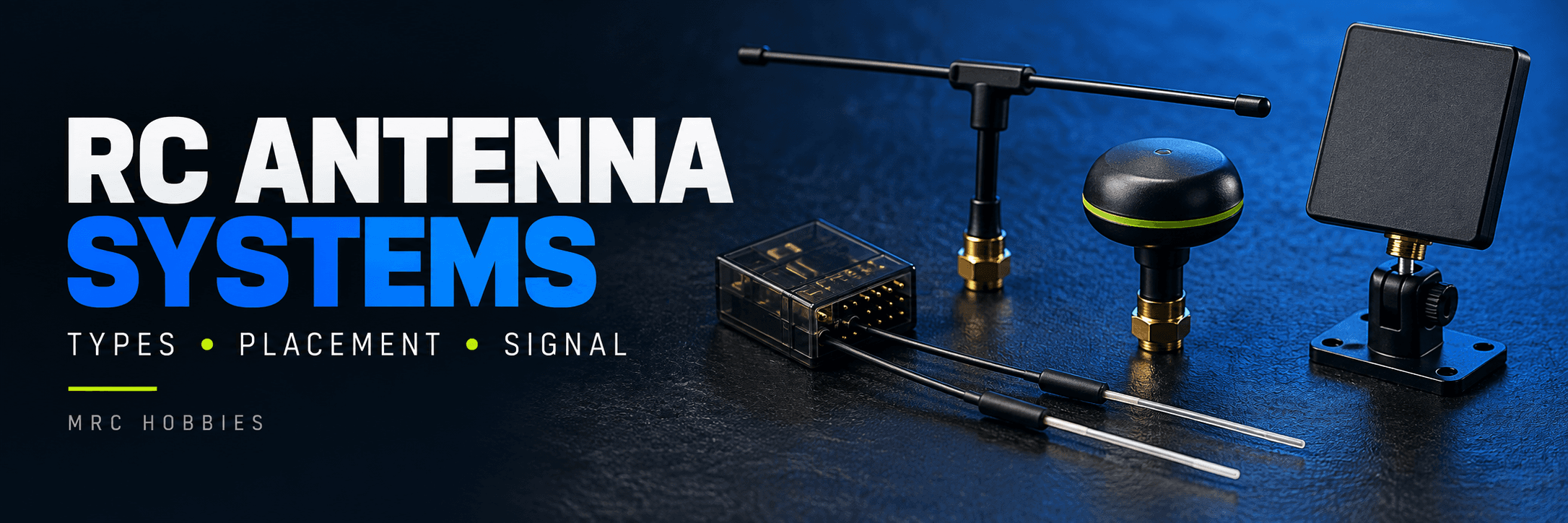
An antenna may look like a simple wire or a small electronic component, but it plays an important role in your RC model’s radio system.
Its design and installation influence how the transmitter and receiver exchange signals. A suitable receiver can still perform poorly if its antenna is damaged, blocked or installed incorrectly.
Understanding antenna systems helps explain why reliable control depends on both equipment selection and physical installation.
What Does an RC Antenna Do?
An antenna connects electrical radio-frequency signals with electromagnetic waves.
A transmitting antenna radiates energy. A receiving antenna captures part of the arriving signal so the radio electronics can process it.
RC equipment can have antennas for control, telemetry and FPV video. These links may use different frequencies and have different requirements.
An antenna suitable for one link is therefore not automatically suitable for another.
1. Wire and Whip Antennas
Some receivers use an antenna that resembles a wire. Others have a coaxial cable ending in an active antenna element.
These designs should not be treated as identical.
The feed cable and active element perform different roles. Follow the receiver’s manual to identify which section needs particular attention during installation.
Avoid shortening, stripping or modifying an antenna using a general measurement found online. The correct arrangement depends on its design.
On an RC car, an antenna tube can provide support, while careful routing helps prevent damage from wheels, gears and moving parts.
2. Dipole and T-Shaped Antennas
A dipole commonly has two elements extending from a feed point. Many compact receiver antennas use a T-shaped arrangement.
ExpressLRS identifies dipoles as a common receiver antenna type. It also documents compact onboard antenna designs. ExpressLRS
A dipole must suit the equipment’s frequency. Its orientation and position also need to follow the hardware’s installation guidance.
The T-shaped appearance alone does not establish compatibility.
3. Ceramic and Onboard Antennas
Small receivers may use a ceramic or other board-mounted antenna.
These designs reduce the need for a separate antenna lead and can simplify compact installations. ExpressLRS documents SMD antenna receivers as part of its hardware options. ExpressLRS
However, compactness does not remove the importance of the receiver’s surroundings.
The installation must still account for the model’s structure and intended use. Neither an onboard antenna nor an external antenna is universally the best choice for every model.
4. Circular-Polarized FPV Antennas
FPV video equipment can use circular-polarized antennas labelled RHCP or LHCP.
These labels describe opposite polarization handedness. TBS’s Triumph documentation specifies matching polarization direction at both ends of the intended link. team-blacksheep.com
A matching connector does not establish matching polarization or frequency.
These video-link choices should also be distinguished from the requirements of your RC control receiver.
5. Directional Patch Antennas
Directional antennas concentrate their coverage toward a particular region. Patch antennas are one example found in FPV equipment.
A directional arrangement can be useful when its coverage suits the task. However, aiming becomes more important because the antenna does not provide equal coverage in every direction.
Directionality is a tradeoff in coverage, rather than a universal improvement. TBS offers patch antennas specifically intended for FPV applications. Team BlackSheep
Comparing Common Antenna Types
TypeMain considerationWire or whipActive element, support and protectionDipoleFrequency suitability and orientationOnboard or ceramicCompact installation and surrounding materialsCircular-polarized FPVFrequency and polarization handednessDirectional patchCoverage direction and aiming
Single Antenna vs Diversity Systems
A receiver with two antennas does not necessarily have two complete radio receivers.
ExpressLRS distinguishes between:
- Single-antenna reception: One antenna.
- Antenna diversity: Two antennas with switching between them.
- Full receiver diversity: A second parallel RF reception path.
Its documentation identifies examples of both antenna diversity and full receiver diversity. ExpressLRS
Diversity provides different reception opportunities. It does not make placement irrelevant or guarantee reception under every condition.
Why Antenna Placement Matters
Conductive structures and components can affect reception.
For its AR637T receiver, Spektrum recommends placing antennas 90 degrees apart and keeping them away from metal, batteries, carbon fibre and fuel tanks. wiki.spektrumrc.com
This is guidance for the specified receiver. Other products may have different installation requirements.
Follow the relevant manual, particularly its identification of the active antenna sections. Protect the installation from mechanical damage and avoid enclosing active elements within unsuitable shielding.
Frequency and Connector Compatibility
An antenna must suit the operating frequency of the equipment.
ExpressLRS offers 2.4 GHz and 900 MHz systems. Its guidance on replacement antennas specifies suitable frequency tuning. ExpressLRS
Connector fit is only one part of compatibility. Check the specified connector type and antenna requirements.
Miniature connectors also need careful handling. Avoid forcing them or repeatedly stressing the cable during installation.
Polarization and Orientation
Antenna orientation can influence reception, particularly as a model turns or changes attitude.
For linearly polarized systems, the relationship between antenna orientations matters. For circular-polarized FPV equipment, the specified handedness must be considered.
Use the installation guidance for the complete link rather than applying one rule to every antenna.
Practical Antenna Checklist
- Identify whether the antenna serves control, telemetry or video.
- Confirm its frequency and connector.
- Follow the receiver’s placement instructions.
- Inspect cables, active elements and connectors.
- Keep antennas clear of moving parts.
- Avoid unsuitable shielding around active elements.
- Perform the manufacturer’s range or link checks.
Common Mistakes to Avoid
Longer does not automatically mean better. Cutting an antenna for convenience can alter its intended design.
Other mistakes include assuming two antennas guarantee true receiver diversity, choosing replacements only by connector and applying FPV antenna advice to an unrelated control system.
Final Thoughts
A reliable antenna installation combines suitable hardware, correct frequency and careful placement.
Understanding the complete system is more useful than selecting an antenna by appearance alone.
Explore RC Technology with MRC Hobbies
Visit MRC Hobbies or contact us with your model and radio details to discuss suitable equipment.
Address: 201, P. N. Kothari Industrial Estate, next to Navkar Hospital, Bhandup West, Mumbai, Maharashtra 400078.
Phone / WhatsApp: +91 77840 93093
Instagram: @mrchobbies
YouTube: MRC Hobbies