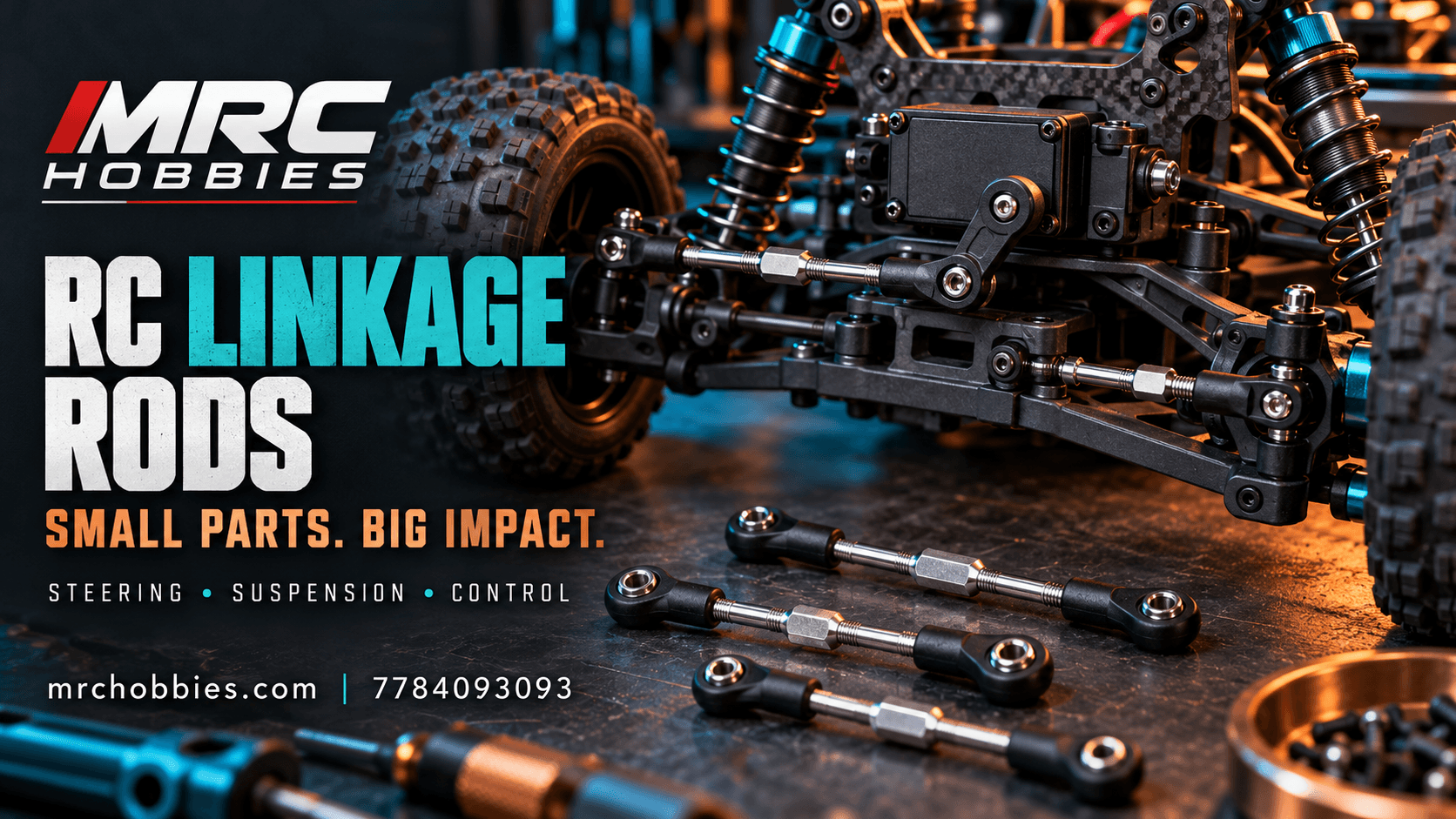
Linkage rods transfer movement or hold parts in position. Depending on the model, they connect steering components, establish suspension geometry or locate a crawler’s axles. A bent rod or worn ball end can affect how your vehicle drives—even when the electronics are working perfectly.
What Are RC Linkage Rods?
A linkage rod is a connecting member, often fitted with ball joints at its ends. These joints allow the rod to change angle as the steering or suspension moves.
Some rods have a fixed length. Others use threaded ends or a turnbuckle so you can adjust their length.
Common examples include:
- Steering links: Transfer steering movement to the wheels.
- Camber links: Help set wheel camber on suitable independent-suspension models.
- Crawler suspension links: Locate solid axles while allowing suspension movement.
- Throttle and brake linkages: Transfer servo movement to mechanical controls on many nitro models.
Each type has a different job, so matching the part to your vehicle matters.
1. More Consistent Steering
When you turn the transmitter wheel, the servo moves the steering mechanism through its linkages.
Worn ball ends introduce play: the servo can move slightly before the wheels respond. Bent or incorrectly adjusted rods can also change wheel alignment.
Healthy linkages help make your steering inputs more predictable, whether you are lining up a jump or positioning a crawler tyre on a rock.
2. Correct Wheel Alignment
On vehicles with adjustable steering links, changing their length affects toe—the direction the wheels point when viewed from above.
Adjustable camber links influence the wheel’s inward or outward tilt when viewed from the front.
These settings affect handling and tyre wear. Start with the manufacturer’s recommended setup and make small, measured changes rather than assuming one setting suits every surface.
3. Controlled Suspension Movement
On a linked solid-axle crawler, suspension links help control axle position and rotation as the suspension moves.
Incorrect link lengths can alter wheelbase, axle orientation and driveshaft angles. Joints that bind can restrict suspension travel.
The goal is secure axle location with smooth movement throughout the intended travel.
4. Less Binding and Unnecessary Load
A linkage should move freely through its operating range.
If a joint binds or a steering mechanism reaches its mechanical stop before the servo stops moving, the servo can remain under load. Correct linkage geometry and suitable steering end points help prevent this.
Stronger rods cannot compensate for an incorrectly assembled mechanism.
Signs Your Linkages Need Attention
Inspect your model if you notice:
- Excessive wheel movement without corresponding servo movement.
- A visibly bent rod or cracked ball end.
- A joint repeatedly popping off.
- Steering or suspension that catches during movement.
- Alignment changing after an impact.
Pulling to one side can have several causes, so also check tyres, servo centring and steering trim.
Choosing Replacement Rods
Check the eye-to-eye length, thread size, ball diameter, mounting hardware and required joint movement.
Material alone does not determine whether a replacement is suitable. A thicker metal rod can still be the wrong length or interfere with nearby parts.
For adjustable rods, maintain adequate thread engagement at both ends. Do not extend them excessively just to achieve the desired length.
Simple Maintenance Tips
After a hard impact, check for bends and loose hardware. Clean dirt from exposed joints and replace worn ball ends.
After any adjustment, move the steering and suspension through their full travel to check for binding. Follow the model’s instructions for lubrication and fastener security.
Find Suitable RC Parts at MRC Hobbies
Need help identifying a linkage rod? Share your vehicle model, a clear photograph and the rod’s eye-to-eye measurement with us.
🛒 Explore RC Parts at MRC Hobbies
💬 Ask About Compatible Linkage Rods
Visit or Contact Us
📍 MRC Hobbies
201, P. N. Kothari Industrial Estate, next to Navkar Hospital, Bhandup West, Mumbai – 400078
Check the small connections—they play a big part in every drive!