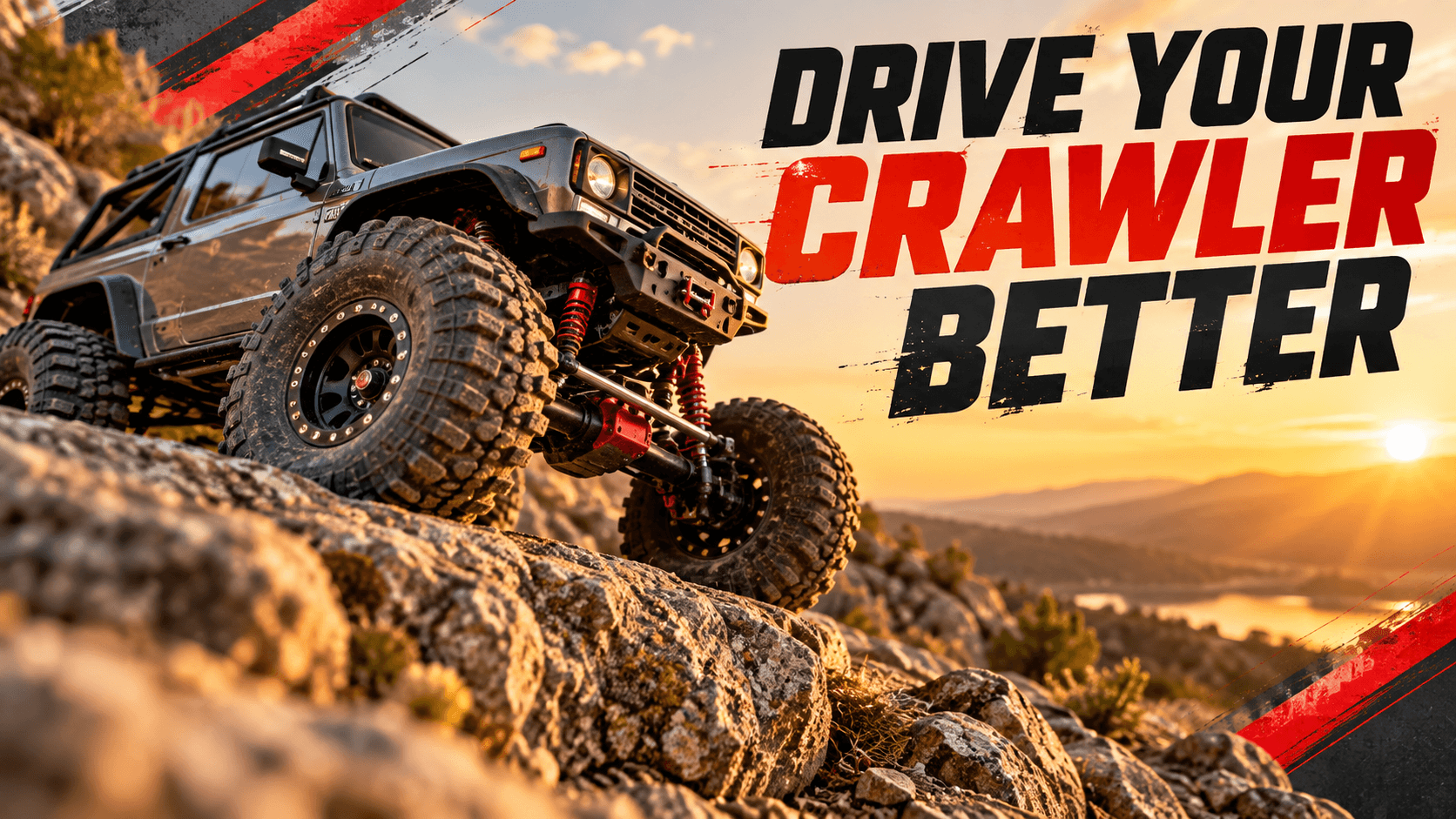
Slow driving can be the biggest challenge
RC crawling is about guiding your vehicle over difficult terrain with precision. Two drivers can use the same crawler and get very different results because their routes and control inputs differ. Before changing parts, practise reading the obstacle and moving the car deliberately.
Look two wheel lengths ahead
Before a climb, identify where your front tyres will first touch and where the rear tyres will follow. Choose a line that gives the tyres grip while keeping the chassis away from sharp edges. An obstacle may look easy from directly behind the car but reveal a better path when viewed from the side.
Watch the belly and differential housings, not just the wheels. A line that puts both axles over a tall ridge can leave the chassis stuck in the middle. Sometimes placing one tyre on a higher rock creates the clearance you need.
Use smooth throttle
Sudden acceleration can spin the tyres and throw the car off its line. Apply power gradually and let the tyres find grip. If the wheels spin without movement, stop, reverse a little and approach from a slightly different angle. Repeatedly forcing the car forward can strain the drivetrain.
When approaching a ledge, let the front tyres make contact before adding enough power to climb. As the rear tyres reach the same ledge, prepare to adjust the steering and throttle again; they may need a different line.
Steering is part of traction
A small steering change can move a tyre onto a grippier patch or help it hook around an edge. Turn in short, controlled movements. Avoid holding the steering at full lock against a trapped wheel, which can put extra load on the servo and steering parts.
Take descents seriously
On a descent, the crawler's weight shifts forward. Approach slowly, keep the vehicle as straight as the terrain allows and make gentle corrections. If the front begins to tip, a different route may be safer than adding speed. Check the vehicle's braking or drag-brake behaviour on a mild slope before attempting a steep one.
Practise with a three-obstacle course
You can learn a lot from a small course: a low bridge or ramp, an uneven rock section and a narrow gate. Drive it once without stopping. Then repeat while aiming for fewer reverses and fewer touches. Time is only one measure; a clean, controlled run is a useful goal for beginners.
Try both directions. A climb in one direction becomes a descent in the other, so the same course teaches different skills. Move one obstacle occasionally to keep the route interesting.
Protect your crawler on outdoor trails
After each run, clear dirt and grass from the wheels and moving parts. Inspect tyres, wheel nuts and steering links. Follow your model's water-resistance guidance; do not assume that every crawler can be submerged because it handled a splash. Let wet parts dry and inspect them before storing the vehicle.
Explore crawling with MRC Hobbies
Ready for your first trail truck or looking for a new crawling challenge? Explore the range at mrchobbies.com and follow our videos and events for ideas you can try on your next outing.
MRC Hobbies · 201, P. N. Kothari Industrial Estate, next to Navkar Hospital, Bhandup West, Mumbai, Maharashtra 400078
WhatsApp: +91 7784093093
Instagram: @mrchobbies