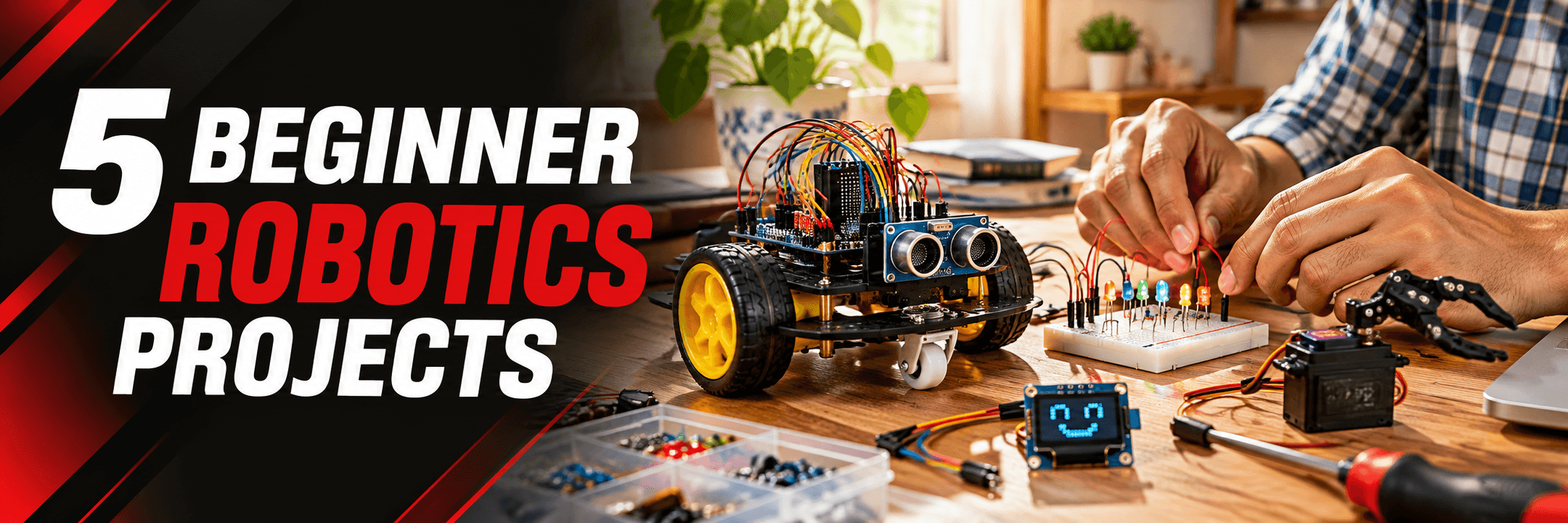
A robot doesn’t have to walk or talk to be interesting. At its heart, robotics is about making something sense, decide, and act. An input such as a button or sensor tells a controller what is happening; the controller then turns on a light, moves a motor, or shows information on a display.
You can learn that process one small project at a time. Here are five ideas you can try at home, starting with a simple circuit and working towards a moving robot.
1. Build a traffic light
What you’ll make: Three LEDs that light up in a red, yellow, and green sequence.
Start by connecting the LEDs to a suitable microcontroller through correctly sized resistors. Program a timed sequence, then add a push button that changes the lights when pressed.
This project introduces basic wiring, outputs, timing, and simple decisions in code. Once it works, try adding a countdown display.
2. Make an automatic night light
What you’ll make: A light that turns on when its surroundings get dark.
Use a light sensor to measure brightness and an LED as the output. Set a threshold in your program: below that level, the LED turns on; above it, the LED turns off.
The fun part is experimenting with the threshold. Test your project in different parts of the room and adjust it until it responds the way you want. You’ll learn how sensor readings become useful actions.
3. Create a mini obstacle alarm
What you’ll make: A device that reacts when something moves close to it.
Pair a suitable distance sensor with an LED or buzzer. Place an object in front of the sensor and watch the output change as you move it closer. You could use different light patterns for different distances.
This is an introduction to the technology behind obstacle-detecting robots. It also teaches you to test a sensor rather than assume every reading will be perfect.
4. Build a simple servo-controlled arm
What you’ll make: A small arm that moves to positions you choose.
A servo motor can move to a commanded angle. Start by making it move between two positions. Then add a knob or button so you can control it yourself.
Keep the first arm lightweight and within the servo’s rated load. This project helps you understand how a robot turns an instruction into physical movement.
5. Make a beginner robot car
What you’ll make: A small wheeled platform that drives and turns.
Once you’ve experimented with outputs and sensors, bring those ideas together. Start with a chassis, motors, a suitable motor driver, controller, and compatible power source. Get the car moving forward and backward first. Then add turning. As a next step, add a distance sensor so it can stop or change direction when it approaches an obstacle.
Build and test one function at a time. If the robot stops working after a change, you’ll know where to look.
What should you build first?
Choose the project that makes you curious, even if it’s the simplest one. A working traffic light teaches more than an unfinished complex robot. Take photos of your wiring, note what each change does, and keep improving your design.
As you gain confidence, you can combine projects: add lights to your robot car, put a display on your obstacle alarm, or control a servo using a sensor. That’s when separate experiments start to feel like your own invention.
Ready to begin? Explore robotics components at MRC Hobbies. Check each component’s voltage, connections, and instructions before powering your project.