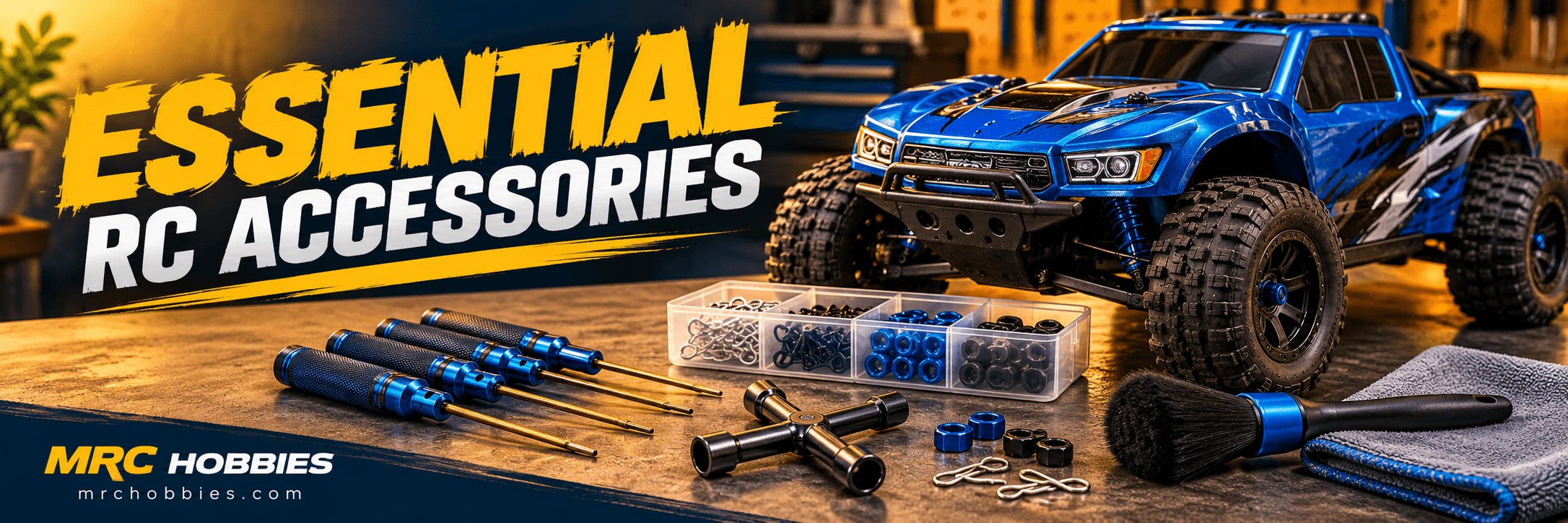
The right accessories help you enjoy your RC car longer
Buying your first hobby-grade RC car is exciting. Once you start driving, however, you quickly discover that the vehicle is only one part of the experience.
A missing body clip can leave the shell unsecured. A loose wheel nut can interrupt a session. The wrong screwdriver can damage a screw that should have been easy to remove.
Useful accessories help you handle these small problems and keep your vehicle ready for the next run.
That does not mean buying every upgrade immediately. Start with accessories that support your actual needs: operating the car, performing basic maintenance, replacing small lost parts, and transporting everything conveniently.
Decorative and performance accessories can follow as you learn what you enjoy.
1. Correctly sized tools
A small set of suitable tools is one of the most useful additions to your RC kit.
Different vehicles use different fasteners. Check your manual before ordering hex drivers, screwdrivers, or nut drivers. A tool that looks close enough may still fit poorly.
Useful tools can include:
- Hex drivers matching your vehicle’s screws.
- A wheel wrench or correctly sized nut driver.
- Suitable Phillips screwdrivers where required.
- Small pliers for appropriate tasks.
- A tray to hold removed hardware.
Good fit matters more than the number of tools in the box. A correctly fitting driver reduces the chance of rounding a screw head.
Avoid tightening every fastener as hard as possible. Plastic threads, small screws, and different materials require appropriate care.
2. Small spares that prevent an early finish
Some inexpensive parts can save a driving session.
Body clips, wheel nuts, and the correct battery strap are worth considering because losing one can make the car difficult or unsuitable to continue driving.
Other spares should reflect your particular model and experience. If you repeatedly damage a certain suspension arm, carrying that exact replacement may be useful.
Use the model’s parts list and exploded diagram to identify replacements. Manufacturer catalogues organise parts and accessories by model, which helps avoid ordering visually similar but incompatible components. traxxas.com
Keep small items in labelled compartments. Mixing several sizes of screws and nuts makes repairs more confusing.
3. Cleaning accessories
A soft brush and microfiber cloth are useful for routine cleaning.
After a dusty run, remove loose dirt from accessible areas without pushing it into bearings or joints. Check around wheel hubs, suspension arms, and cooling openings.
A cleaning kit does not need to be complicated. Start with:
- A soft brush.
- A clean microfiber cloth.
- A suitable work mat.
- Any cleaning products specifically approved for your vehicle’s materials.
Do not assume every RC car can be washed with a hose. Follow the manufacturer’s cleaning instructions, including any drying and maintenance requirements after wet use.
Cleaning also gives you an opportunity to spot loose hardware, damaged tires, and worn components.
4. A compatible battery and charger
A spare battery can extend a session, but compatibility comes first.
Check the permitted battery chemistry and cell count, connector, physical dimensions, and mounting arrangement. Confirm that the charger supports the battery and its required charging procedure.
These requirements are model-specific. For example, manufacturer manuals list particular battery configurations, connectors, and charging equipment rather than treating all packs as interchangeable. traxxas.com
A larger battery is not automatically a better choice. It may not fit, may add unwanted weight, or may exceed the vehicle’s electrical limits.
Follow the battery and charger instructions for charging, cooling, inspection, and storage. Do not continue using a damaged pack.
5. Tires suited to your driving surface
Tires are worth considering when your usual driving surface differs from the surface the original tires suit.
A road-focused vehicle, a dirt-track buggy, and a crawler need different kinds of grip. Tread, rubber compound, inserts, and dimensions all contribute to the result.
Before buying, check:
- Wheel mounting compatibility.
- Tire diameter and width.
- Wheel offset.
- Body and suspension clearance.
- Suitability for the vehicle and terrain.
Larger tires can affect gearing load and steering clearance. Choose a set for a defined purpose rather than appearance alone.
If your existing tires perform well, there is no need to replace them immediately.
6. A parts organiser and work mat
Organisation makes RC maintenance easier.
A compartment box keeps body clips, screws, wheel nuts, and small replacement parts together. Labels help you distinguish parts for different models.
A work mat provides a clear repair area and helps keep removed hardware visible. A small tray is particularly useful when working outdoors or at an event.
Keep frequently used tools in one place and store instructions or part numbers alongside the relevant spares.
A neatly organised kit can save more time than an unnecessary upgrade.
7. A carry bag or suitable transport case
Transport is part of the hobby, especially when you drive at tracks, trails, or events.
Choose a bag or case that fits the vehicle without forcing the wheels, body, or accessories into an awkward position.
Keep the transmitter protected and prevent loose tools from striking the body. Follow the battery manufacturer’s guidance for transporting packs, including protection against damage and short circuits.
A separate container for a dirty vehicle can also help keep tools and other equipment clean.
Before leaving, check that you have the transmitter, required batteries, tools, and essential spares.
8. A maintenance stand
A suitable stand can make wheel removal, cleaning, and inspection more convenient.
Choose one that supports the chassis securely without loading fragile body panels. Confirm that its size and capacity suit your vehicle.
For ordinary maintenance, disconnect the drive battery. A raised car should not be treated as permission to run the drivetrain at high speed.
A stand is useful, but it can wait if you already have a stable, suitable workspace for basic tasks.
9. Decorative accessories and scale details
Once the essential kit is ready, appearance accessories can make the vehicle more personal.
Options include decals, body graphics, compatible light kits, and suitable scale details. For crawlers, selected accessories can support an expedition-style theme.
Check fitment and attachment before purchasing. Decorative parts should not obstruct steering, suspension movement, body removal, or cooling.
Electrical accessories also require the correct voltage and connection method. Mechanical accessories need secure mounting.
Consider weight, especially when fitting items high on the vehicle. Add a few details at a time and inspect them after driving.
What should a beginner buy first?
PriorityAccessoriesPurposeStart hereRequired battery and charger, if not includedOperate the vehicle correctlyBasic kitCorrect tools, brush, cloth, and small organiserMaintain and inspect the carSession supportCompatible body clips, wheel nuts, and essential sparesHandle minor interruptionsBuy when neededSpare battery, terrain-specific tires, transport caseSupport your driving routinePersonalise laterDecals, lights, scale details, and optional upgradesImprove appearance or address a specific goal
This order is a starting point. Check what your car already includes before buying duplicates.
Common accessory-buying mistakes
The biggest mistake is purchasing an accessory without checking the exact model and version.
Other mistakes include buying a complete upgrade set before identifying a problem, choosing tools by appearance, and assuming a connector alone proves battery compatibility.
Avoid buying every spare listed for the vehicle. Begin with small essentials, then use your driving experience to decide what deserves space in the kit.
A useful question before each purchase is: Which problem will this accessory solve?
Final thoughts
The most useful RC accessories help you drive, maintain, organise, and transport your vehicle.
Start with compatible equipment, correct tools, a simple cleaning kit, and a few small spares. Add tires, decorative details, and other accessories when they serve a clear purpose.
A practical accessory kit keeps the focus on enjoying your RC car.
Explore RC cars, parts, and accessories: MRC Hobbies
Need help checking compatibility? Share your exact RC model and the accessory you are considering on WhatsApp.
Visit: MRC Hobbies, 201, P. N. Kothari Industrial Estate, next to Navkar Hospital, Bhandup West, Mumbai, Maharashtra 400078
Phone / WhatsApp: +91 77840 93093
Instagram: @mrchobbies
YouTube: MRC Hobbies