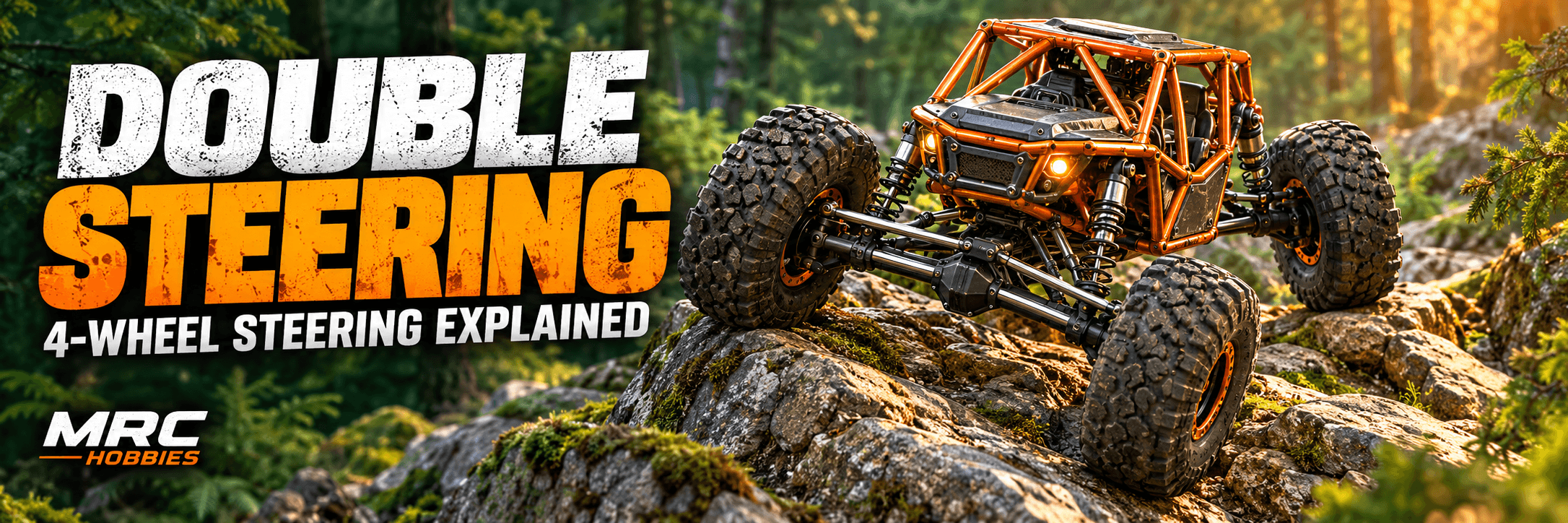
What If Your RC Car Could Steer From Both Ends?
Imagine driving your RC crawler between two rocks. The front wheels clear the gap, but the rear wheels are heading toward an obstacle. With conventional steering, you might need to reverse and try another line.
With rear steering, you have another option: reposition the back of the vehicle while continuing your manoeuvre.
This is the appeal of four-wheel steering, sometimes called double steering in casual RC discussions. It adds a new layer of control to crawling and obstacle driving.
In this guide, “double steering” means steering at both the front and rear axles. Two servos operating only the front wheels is a different arrangement.
What Is Four-Wheel Steering?
On a conventional RC car, the front wheels steer while the rear wheels remain pointed along the chassis.
A four-wheel-steering vehicle has steering mechanisms at both ends. The driver can change the direction of the front and rear wheels, depending on the controls available.
For example, Axial’s Capra 1.9 4WS uses a steering axle and servo at each end, with rear steering controlled through the transmitter. Axial Adventure
Does 4WD Mean Four-Wheel Steering?
No. These terms describe separate functions:
TermWhat It Means4WD — Four-Wheel DriveMotor power reaches all four wheels4WS — Four-Wheel SteeringBoth front and rear wheels can steerDual front steering servosTwo servos operate the front steering mechanism
A vehicle can have four-wheel drive with conventional front steering. Always check the steering specification separately.
The Main Steering Modes Explained
Available modes depend on the vehicle and radio system. Some models provide selectable modes; others let you control rear steering separately.
The Danchee Ridgerock, for example, offers front-only, rear-only, four-wheel and crab steering modes. Redcat Racing
Steering ModeFront WheelsRear WheelsMain PurposeFront-only steeringSteerStay centredFamiliar everyday controlRear-only steeringStay centredSteerReposition the rear of the vehicleOpposite-phase steeringSteer one waySteer the opposite wayMake tighter turnsCrab steeringSteer one waySteer the same wayMove diagonally while keeping a similar heading
1. Front-Only Steering
This behaves like a conventional RC car. It is a useful starting mode while learning the vehicle.
You can concentrate on throttle control, tyre placement and choosing a route before adding rear steering.
2. Rear-Only Steering
Rear-only steering lets you influence where the back of the vehicle goes while the front wheels stay centred.
It takes practice because the vehicle reacts differently from familiar front steering. Begin on an open, flat surface before trying narrow obstacles.
3. Opposite-Phase Steering: Tighter Turns
In this mode, the front and rear wheels steer in opposite directions relative to the chassis.
At crawling speeds, this can reduce the turning radius compared with front-only steering. It is useful when navigating around rocks or entering a tight corner.
The actual improvement depends on wheelbase, available steering angle, tyre grip and terrain. A 4WS crawler still needs room to turn.
4. Crab Steering: A Diagonal Approach
In crab mode, the front and rear wheels point in the same direction relative to the chassis.
With similar steering angles, the vehicle can travel diagonally while maintaining approximately the same heading. This can help change your approach to an obstacle.
Crab steering does not mean the car can move directly sideways like a vehicle with specialised omnidirectional wheels.
Why Is Rear Steering Useful for RC Crawling?
Crawling is about placing tyres carefully and finding a route that the vehicle can follow.
Rear steering gives you another way to adjust that route. Instead of controlling only the front axle’s direction, you can also influence where the rear tyres travel.
It can help when:
- Negotiating narrow passages.
- Turning around obstacles.
- Positioning rear tyres on a chosen line.
- Correcting an awkward approach at low speed.
- Exploring different routes through a crawling course.
Axial describes rear steering on its Capra 4WS as a way to position tyres more precisely when tackling obstacles. Axial Adventure
However, steering cannot replace traction, ground clearance or good weight distribution. A rear-steering system will not automatically solve every difficult climb.
How Does the System Work?
A typical hobby-grade crawler setup includes:
ComponentIts RoleFront steering servoOperates the front steering linkageRear steering servoOperates the rear steering linkageSteerable rear axle or hubsAllow the rear wheels to turnSteering links and servo mountsTransfer servo movement to the wheelsCompatible transmitter and receiverProvide the required controlSuitable power supply or BECSupplies the steering electronics
A BEC provides the regulated voltage used by the receiver and servos. With two steering servos, check both voltage compatibility and the available current capacity.
Servo torque alone is not enough to judge compatibility. Mounting dimensions, servo-horn spline, operating voltage, clearance and radio control also matter.
Can You Add Double Steering to Any RC Car?
Not every RC car is suitable for a conversion.
A fixed rear axle usually needs more than an extra servo. Depending on the design, you may need a different axle housing, steering knuckles, suitable axle shafts, links, mounts and compatible electronics.
Axial’s published Capra conversion instructions illustrate this: they specify steering hardware and drivetrain components as well as a servo and horn. That parts list applies to the stated Capra configuration, rather than every crawler. Axial Adventure
Before buying conversion parts, check:
- Whether your chassis supports a steerable rear axle.
- Whether compatible parts exist.
- Whether the tyres and links have enough clearance.
- Whether the radio can provide the control you want.
- Whether the electronics can power both servos.
For basic RC toys with integrated electronics and fixed assemblies, a conversion may require extensive redesign.
Do You Need a Special Transmitter?
You need a radio system that supports the intended steering arrangement.
Channel count by itself does not guarantee suitable control. An additional channel might be a simple switch, a multi-position control or a proportional input.
Look for the features your setup requires:
- Independent rear-steering control.
- Steering mixing or selectable 4WS modes.
- Servo reversing.
- Centre adjustment.
- Endpoint adjustment.
A simple Y-harness gives both servos a shared command. By itself, it cannot provide independent front and rear control or selectable steering modes.
Setup Tips Before Your First Drive
Centre Both Steering Systems
Follow the radio and vehicle instructions to centre the servos before setting the horns and links. Confirm that the wheels sit correctly in the neutral position.
Check Steering Direction
Test each axle at low speed. Servo installation and linkage layout affect the movement, so verify the result rather than assuming both servos need identical settings.
Set Safe Endpoints
Limit travel before the steering reaches a mechanical stop, the tyres rub heavily or the drivetrain binds.
Check Full Suspension Movement
A setup that clears on flat ground may interfere when the axle articulates. Check clearance throughout the suspension’s travel.
Practise One Mode at a Time
Start with front-only steering, then learn rear steering and combined modes. Use slow throttle inputs while observing the rear tyres.
Common Double-Steering Mistakes
- Buying a servo without checking axle compatibility.
- Assuming every extra radio channel provides proportional control.
- Using excessive steering travel.
- Ignoring the electrical demand of two servos.
- Switching modes without understanding the vehicle’s instructions.
- Using rear steering to compensate for damaged or loose components.
If you plan to compete, check the event rules before modifying your crawler. Rear steering may affect which class you can enter.
Is Double Steering Right for You?
Four-wheel steering is worth exploring if you enjoy technical crawling, experimenting with tyre placement and learning more advanced vehicle control.
For casual driving, conventional steering remains easy to learn. For a crawler enthusiast who wants more ways to approach obstacles, rear steering adds an engaging new skill.
Explore RC Cars and Hobby Accessories at MRC Hobbies.
Planning a rear-steering upgrade? Contact MRC Hobbies on WhatsApp with your model name, radio details and clear chassis photos to discuss compatibility and availability.
Contact & Follow MRC Hobbies
📍 Address:
MRC Hobbies, 201, P. N. Kothari Industrial Estate,
Next to Navkar Hospital, Bhandup West,
Mumbai, Maharashtra – 400078, India.
📞 Phone: +91 77840 93093
✉️ Email: contact.mrchobbies@gmail.com
▶️ YouTube