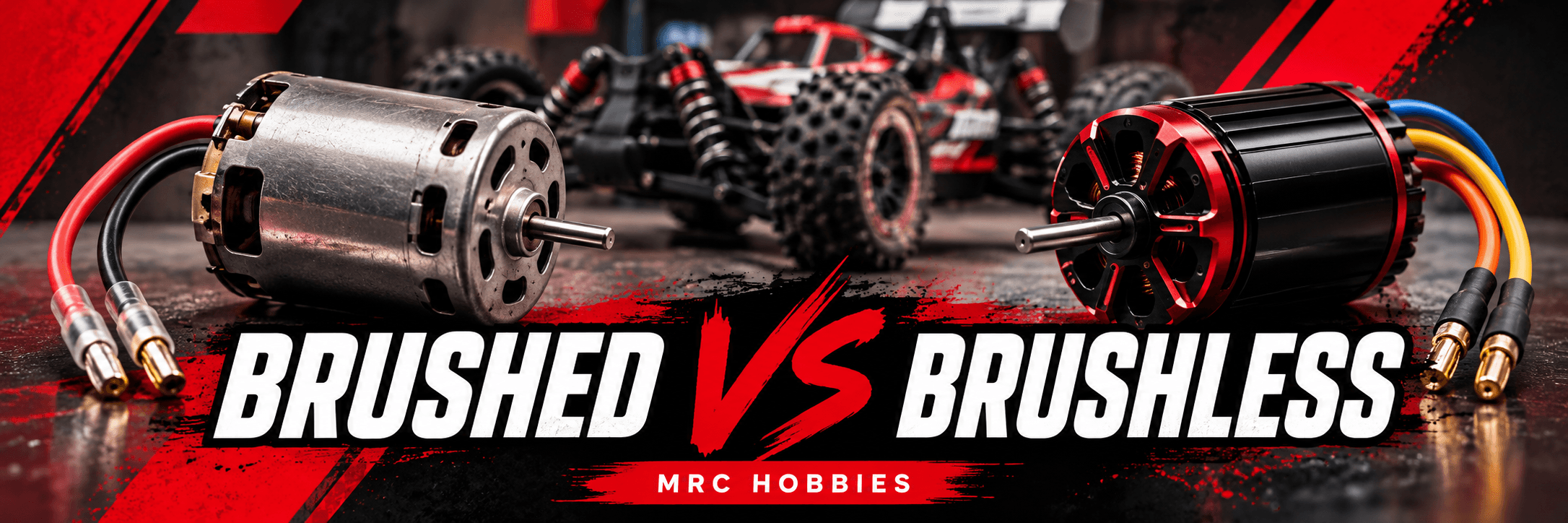
The motor changes how an RC car feels
Two RC cars can look nearly identical and behave very differently when you pull the trigger. The motor, ESC, battery, and gearing work together to determine acceleration, control, and heat. Understanding the two common motor types helps you choose a car or plan an upgrade sensibly.
What is a brushed motor?
A brushed motor uses physical brushes and a commutator to switch current as it spins. It is familiar, straightforward technology found in many entry-level RC vehicles. Brushes are wear items, so the motor's long-term care depends on its design and whether it can be serviced. A brushed setup can be enjoyable for casual driving and controlled trail use; it is not automatically the wrong choice because a brushless option exists.
What is a brushless motor?
A brushless motor uses an electronic speed controller to switch the motor windings without mechanical brushes. Eliminating brush wear is one advantage, and brushless systems can deliver strong performance and efficiency. The result still depends on motor size, Kv, ESC, battery, gearing, vehicle weight, and driving conditions. A powerful brushless system in a poorly matched car can be difficult to control or run too hot.
ConsiderationBrushedBrushlessMotor switchingMechanical brushes and commutatorElectronic switching by a compatible ESCBrush wearBrushes wear during useNo motor brushes to wearTypical buying appealSimple, often lower entry costStrong performance and broad tuning optionsUpgrade requirementBrushed-compatible ESCBrushless-compatible ESCDriving resultDepends on full setupAlso depends on full setup; not every brushless car is faster
What does Kv mean?
A brushless motor's Kv rating describes its approximate no-load RPM per volt. It does not directly measure torque or guarantee a particular top speed. Wheel speed also depends on battery voltage, gearing, tire size, and load. Compare motors using the vehicle maker's recommendations, not Kv alone.
Sensored and sensorless: why crawlers care
Some brushless systems use a sensor connection to give the ESC rotor-position information, which can improve control at very low speed. Sensorless systems can still work well, but the feel depends on the particular motor and ESC. If slow, precise crawling matters most, ask to see how the complete system starts and responds under load.
Before converting a car
Check the motor mount and available space, shaft and pinion fit, ESC compatibility, battery limits, connector type, drivetrain strength, and gearing advice in the model manuals. Start conservatively and check motor and ESC temperatures during the first runs. A motor swap without a suitable ESC is not a complete conversion.
Final thoughts
Choose a motor system for the way you drive. Brushed can suit a simple, approachable setup; brushless offers compelling performance and tuning when the whole vehicle is matched to it. The best upgrade is one that improves your actual driving experience while staying within component limits.
Explore RC cars and electronics: MRC Hobbies
Visit: MRC Hobbies, 201, P. N. Kothari Industrial Estate, next to Navkar Hospital, Bhandup West, Mumbai, Maharashtra 400078
WhatsApp: +91 77840 93093
Instagram: @mrchobbies
YouTube: MRC Hobbies