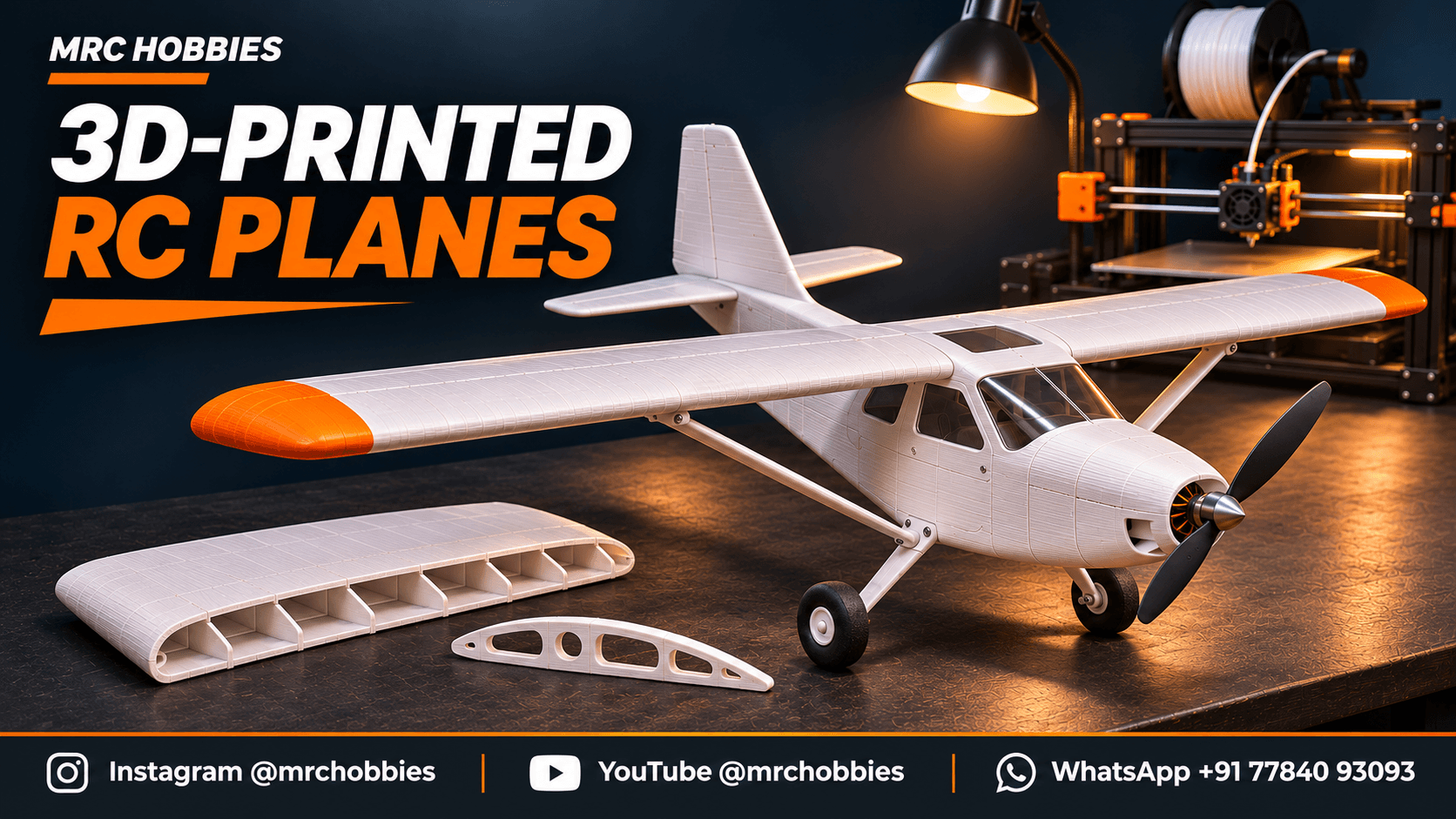
Four project ideas for different skill levels
ProjectGood fit forWhat you’ll learnHand-launch gliderA first printing project or maker-club demoHow small changes to balance and tail trim change the glideHigh-wing electric trainerA first full RC buildInstalling servos, setting up a brushless power system and balancing the finished modelBush-style RC planeBuilders ready for a more involved airframeFitting landing gear and keeping the weight in check as you add hardwareHybrid build with printed partsPilots who already have a foam or balsa aircraftModelling practical parts such as a hatch, camera holder or servo cover
A high-wing trainer is a practical first powered project. Look for a design with a detailed assembly guide, a specified centre of gravity and a matched electronics list. Modular wings and fuselage sections also make it easier to print a replacement after a mishap.
What you need beyond the printed parts
For a typical powered RC plane, budget for a brushless motor, ESC, propeller, servos, transmitter, receiver, flight battery and compatible charger. Depending on the design, you may also need a carbon-fibre spar, pushrods, hinges, control horns and hardware. Match the motor, propeller, ESC and battery as a set using the aircraft designer’s recommendations.
Start with the filament and slicer settings specified for your design. Many lightweight airframes call for LW-PLA, a foaming filament that can reduce printed weight when properly tuned. Some designs provide separate standard PLA profiles. Print one test section first and compare its weight and fit with the designer’s guide before committing to the full build.
From test print to maiden flight
- Check printer fit. Confirm that the largest section fits your print bed and that your nozzle matches the profile.
- Dry-fit the airframe. Check the wing alignment, spar fit and access to the battery and electronics before gluing.
- Set up the controls. With the propeller removed, confirm control directions, servo travel and radio failsafe using the model and radio manuals.
- Balance the finished aircraft. Install the flight battery and check the centre of gravity at the point specified in the build guide.
- Plan the first flight. Use a permitted flying site, pick calm conditions and have an experienced pilot help if you’re new to fixed-wing RC.
Turn the build into a school or college project
Have students weigh each printed section and record how hardware and battery placement affect the finished model’s balance. A separate hand-launch glider makes it easy to demonstrate how changing the centre of gravity or elevator trim affects flight before moving to a powered build.
If you’re planning an aeromodelling project, maker workshop or college prototype, share your airframe plans and parts list with MRC Hobbies. We can help you identify which RC components to look for.
Visit and follow MRC Hobbies
Store address
201, P. N. Kothari Industrial Estate, next to Navkar Hospital, Bhandup West, Mumbai 400078
- Phone / WhatsApp · +91 77840 93093
- Email · contact.mrchobbies@gmail.com
- Website · mrchobbies.com
- Instagram · @mrchobbies
- YouTube · MRC Hobbies
What would you build first — a glider, a high-wing trainer or a bush plane with oversized wheels?