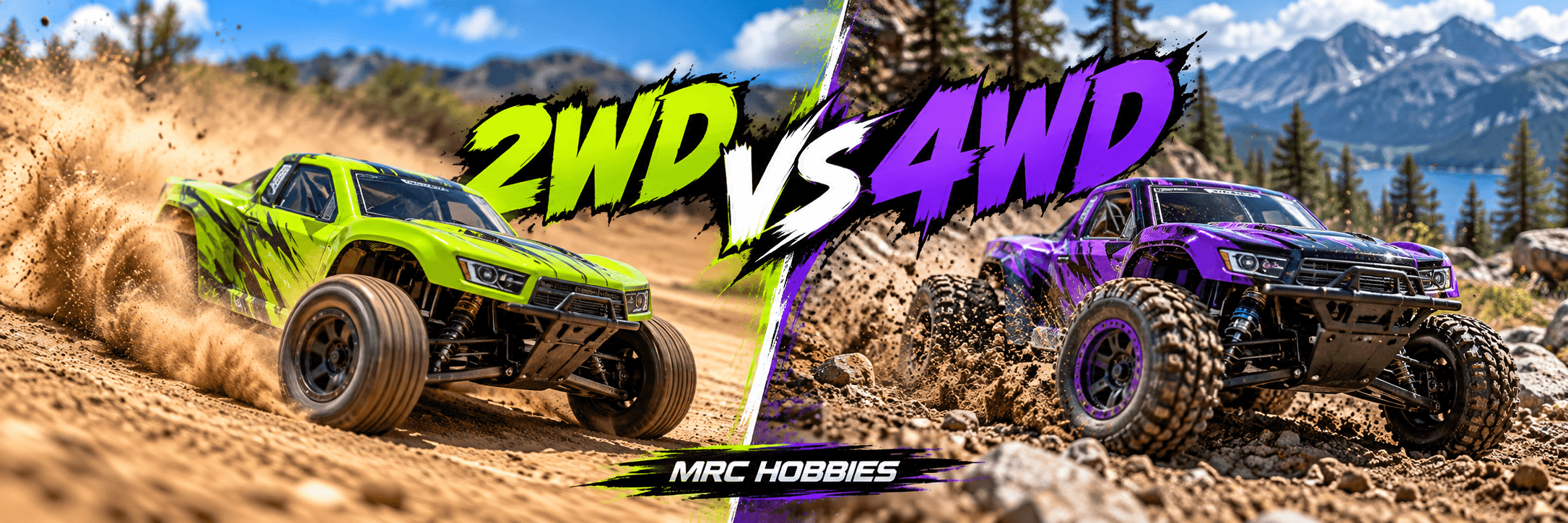
More driven wheels change the feel
Choosing an RC car is not only about scale, speed, and appearance. Its drivetrain changes the way it accelerates, turns, and handles loose ground. In a 2WD car, the motor drives one axle—commonly the rear. In a 4WD car, power reaches both the front and rear axles. That does not mean 4WD wins in every situation. It means the two cars ask different things of the driver.
How 2WD feels
A rear-drive RC car can be lively and rewarding. You learn to apply throttle carefully as the rear tires gain or lose grip. On a smooth surface, a well-set-up 2WD car can be quick and precise. On loose dirt, too much throttle may spin the driven wheels or start a slide. Many drivers enjoy exactly that playful response.
A simpler drivetrain may also mean fewer driven components to inspect, though the actual ease of repair depends on the chassis. A 2WD model is a sensible first car if you want to learn car control and can drive in an appropriate space.
How 4WD feels
A 4WD car can distribute drive to front and rear tires, often helping it put power down on loose or uneven ground. This is attractive for mixed-terrain bashing, rally-style driving, and crawling. ARRMA, for example, describes extra traction as the reason for its model-specific 2WD-to-4WD BOOST conversion.
Four driven wheels do not create grip where the tires have none. Tires, suspension, weight, ground clearance, and driver inputs still matter. A 4WD model may also include more shafts, gears, joints, and differentials to maintain.
Comparison at a glance
Factor2WD RC car4WD RC carDriven axlesOneFront and rearLoose-ground accelerationMore likely to spin driven tires under heavy throttleOften easier to put power downCornering characterRewards smooth throttle and can slide readilyOften feels more planted when acceleratingDrivetrain inspection Usually fewer driven partsMore driven parts to inspect Terrain fit Great on suitable tracks and open surfacesUseful on mixed, loose, and technical surfacesSkill developmentStrong lesson in throttle controlStrong lesson in using available traction and line choice
Which is better for specific driving?
A prepared track: A 2WD buggy is an enjoyable, established way to learn smooth racing lines; a 4WD buggy may offer more drive out of turns. Follow the track's class rules when entering an event.
Loose dirt and grass: 4WD can help with acceleration, although tall grass also strains the power system and may wrap around axles. Tire choice and ground clearance remain important.
Rock crawling: Driving both axles is particularly useful when one end of the car has poor traction. Compare crawling-specific designs rather than assuming a fast 4WD basher will crawl well.
Drifting: Both drivetrain layouts can produce different drifting styles. Choose for the surface, tires, and kind of control you want.
What about price and maintenance?
Look at the complete package, including battery, charger, spare parts, tires, and repair access. A lower purchase price does not tell you the full ownership cost. If you are considering a future conversion, verify that the manufacturer offers a kit for that exact chassis and version. ARRMA's BOOST conversion is an example, not a universal feature of 2WD cars.
A practical test-drive checklist
- Accelerate gently and then more firmly on the surface you plan to use.
- Drive the same turn at a repeatable pace and notice how each car responds to throttle.
- Check whether the car has enough ground clearance for your usual route.
- Inspect how easy it is to clean and reach common repair parts.
- Compare spare-parts availability before choosing a model.
Example: one track, two driving styles
Picture two similar RC short-course trucks on a loose dirt track. The 2WD driver may need to roll onto the throttle after a corner to keep the rear tires from spinning. The 4WD driver may be able to accelerate earlier, but can still run wide by entering too fast. Neither layout erases the need for a clean line. Their differences make a side-by-side test interesting, especially when both use tires suited to the same ground.
On a small paved area, the comparison may feel different. The 2WD car's slides can be fun at sensible speeds, and the extra traction of 4WD may be less decisive. On rocky trails, ground clearance, articulation, tire compound, and gearing are as important as the number of driven axles. This is why a purpose-built crawler should not be judged against a speed-focused truck by drivetrain alone.
Common buying mistakes
- Assuming any 4WD model is a capable rock crawler, regardless of tires or gearing.
- Assuming 2WD is always slower; class rules, surface, tires, and setup can change the comparison.
- Comparing a powerful 4WD car with an entry-level 2WD car and attributing every difference to the drivetrain.
- Forgetting that a 4WD chassis may require more drivetrain inspection after dusty or muddy runs.
How to choose at MRC Hobbies
Tell us where you actually plan to drive: smooth road, RC track, loose dirt, grass, or a crawling course. Also share whether you want slides and skill-building, predictable acceleration, or slow obstacle driving. That information helps narrow the models before comparing the battery, motor, size, and spare-part support.
Final thoughts
Choose 2WD if you enjoy a lively car, a suitable driving area, and learning careful throttle control. Choose 4WD if you regularly drive loose or uneven terrain and value drive from both axles. The better RC car is the one whose complete design fits your terrain and driving style.
Explore RC cars and accessories: MRC Hobbies
Visit: MRC Hobbies, 201, P. N. Kothari Industrial Estate, next to Navkar Hospital, Bhandup West, Mumbai, Maharashtra 400078
WhatsApp: +91 77840 93093
Instagram: @mrchobbies
YouTube: MRC Hobbies